Posted: Wed Sep 02, 2009 9:06 pm
Post subject: Need "Budy" & "Kreis" explained.
On several village names for my ancestors, I find: "Budy" some name..
what does the "Budy" mean?
in one case I have "Wielgie Or Budy Wielgie" as the village name.
Also, I often find "Kr." which is (I believe) short for Kreis, such as in "Kr. Lipno" .. again, what does the Kr. (Kreis?) mean?
I know I've seen Gmina and Powait (sp?) explained, but I don't recall seeing these others explained. If it's all part of smaller subdivisions, perhaps a full explaination would help
Buda is a small, poor, trashy building. Budy is a plural form of Buda. There are dozens of towns and villages which names start with Budy or Buda, often with the second word deriving from another, usually bigger, town. Examples: Budy Łańcuckie -> from Łańcut, Budy Gogołowskie -> from Gogołów.
This name has nothing to do with official territorial division (starting from the biggest): województwo - voivodeship, province; powiat - county; gmina - borough; miasto - town, city; wieś - village.
As for Kr., do you have any more examples aside from Kr. Lipno
BobK PO Top Contributor
Joined: 11 Nov 2008 Replies: 231 Location: Portland, Oregon USA
Thanks for the explanation of "Budy". Is that always an 'official' part of the name, or a slang expression of the "bad side of town"?
Zenon wrote:
As for Kr., do you have any more examples aside from Kr. Lipno
I just tried it in Google translate and Kreis translates in German to: circle, round, circuit, sphere, cycle, orbit, district, set, ward or constituency ..
So I guess "Kreis Lipno" would be "in the area of Lipno" or "the Lipno District" etc..
The triangle of Lipno to Rypin to Dobrzyn was known as "Dobriner-land" when it went back & forth between West Prussia and Poland. (Dobrin was the original Prussian name of Dobrzyn).
I've found my German ancestors being born in several towns in that area. The word "Kreis" was used in some of their documents. I suspect that a farm that isn't part of any other village was said to be in "Kreis Lipno" or whatever the closest large town was.
As an aside, I've noted many German surnamed people marrying Polish surnamed spouses. Even Polish surnamed families attending the German language Lutheran churches in that area.
I'm trying to find the ethnicity breaksown of Poland's population back in the 1800's. There must've been quite a diverse population back then!
Polish, Lithuanian, German, Jewish, etc etc..
Just to the south of Gdansk, there's a small area named "Krepiec". When it was Danzig and in Prussia, Krepiec's original Prussian (German) name was "Krampitz" my original family name.
Thanks for the explanation of "Budy". Is that always an 'official' part of the name, or a slang expression of the "bad side of town"?
This is usually an 'official' part of the name.
BobK wrote:
As an aside, I've noted many German surnamed people marrying Polish surnamed spouses. Even Polish surnamed families attending the German language Lutheran churches in that area.
I'm trying to find the ethnicity breaksown of Poland's population back in the 1800's. There must've been quite a diverse population back then!
Polish, Lithuanian, German, Jewish, etc etc..
Just to the south of Gdansk, there's a small area named "Krepiec". When it was Danzig and in Prussia, Krepiec's original Prussian (German) name was "Krampitz" my original family name.
Bob K.
Very good source of such in information, however in micro scale for specific villages, is Słownik geograficzny Królestwa Polskiego (Geographical Dictionary of the Kindgom of Poland) from 19th century, available online ( http://dir.icm.edu.pl/pl/Slownik_geograficzny/ ), but only in Polish. You can find there information about given villages, how large they were, who owned them, who lived there, how many Roman catholics, Lutherans, Jewish etc. Your Krampitz is on page 608 in volume 4 http://dir.icm.edu.pl/pl/Slownik_geograficzny/Tom_IV/608 . It is shortly described as a property belonging to a hospital, Gdansk county, in Krępiec area.
BobK PO Top Contributor
Joined: 11 Nov 2008 Replies: 231 Location: Portland, Oregon USA
Thanks! That online book, unfortunately, is all page images - so I can't easily get google to translate the Polish (typing in the words isn't easy without a Polish keyboard!) But I see it is dated 1880, so there would be some great information for genealogy research by Polish readers.
Bob K.
harufam
Joined: 12 Oct 2013 Replies: 39 Location: Normantown, WV, USA
Posted: Sun Oct 13, 2013 7:52 pm
Post subject: MEANING OF THE WORD BUDY WHEN USED IN HEADING
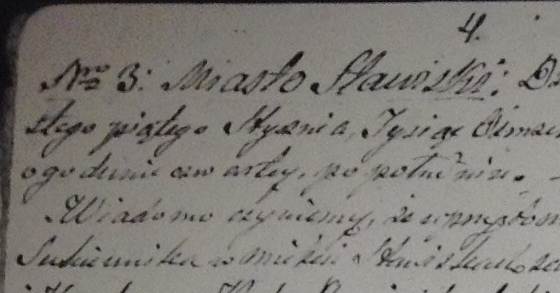
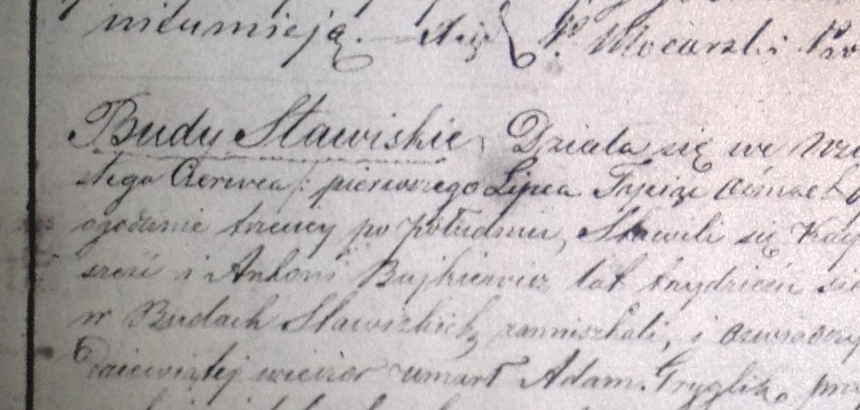
The meaning of Budy Stawiskie as a location rather than just plain Stawiski (the name of the village) or as is sometimes Miasto Stawiskie. The only translation of the word Budy I can find is "hut" (a small building or house). Could this possibly mean that the birth or death occurred at home?, as in "At home in Stawiskie"? This is probably very simple for most of you, but for me it is truly a puzzle.
Thank you for any assistance you can offer.
Chuck
IMG_0088-001.JPG
Description:
Filesize:
68.62 KB
Viewed:
13554 Time(s)
IMG_0082-001.JPG
Description:
Filesize:
152.25 KB
Viewed:
13554 Time(s)
_________________ Researching the Lomza area (Kolno, Poryte, Dobry Las etc) for Charubin, Zonak, Koldys, Siwik
Buda, 200-300 years ago simply meant "structure," and when used in this context, it refers to a "gathering of structures," or a small, unincorporated town. It could have been a group of houses and outbuildings owned by the Stawiski family, or several others. Elzbieta and other Polish speakers can offer more clarification.
Posted: Mon Oct 14, 2013 1:28 am
Post subject: Budy Stawiskie
Chuck,
The full name of the village is Budy Stawiskie. Indeed the word "budy" means some huts, small buildings, but it is also a popular name of the villages in Poland. As there is a lot of different Budy on Polish map, to make the identification easier the name has two parts: Budy Stawiskie (as it is located in Stawiski administrative community)
According to Stawiski town site http://www.stawiski.pl/index.php?k=11 Budy Stawiskie is a wieś włościańska (village with owner), thus Staripolak64 is right in his explanation.
I just like to note, that other origin of prefix Budy is a place where Budnicy https://pl.wikipedia.org/wiki/Budnicy were living and producing tar, charcoal, rosin, potash and other forest wood products.
Elzbieta Porteneuve PO Top Contributor
Joined: 09 Nov 2012 Replies: 3098 Location: Paris, France
Posted: Mon Oct 14, 2013 5:13 am
Post subject: Kolonia, Budy, little houses
Staripolak64/Richard is right with budy's explanation, gathering of structures.
Sirdan's link with Budnicy gives a pretty picture of Kurna chata - a hut in cold country.
Here is something similar, more recent (not allowed anymore), in French Normandy, Summer huts overlooking the sea, http://int.manche-tourismus.com/img_slide/gouville.jpg
I wonder what is the difference between Kolonia and Budy.
Kolonia is an extension of a village, a settlement of people (therefore houses).
According to this http://xvii-wiek.ijp-pan.krakow.pl/pan_klient/index.php?strona=haslo&id_hasla=8253, buda was "a small building constructed from flimsy materials" - I perceive that definition as somehow giving a judgement. I do not see it that way, maybe because when I was child I read so many Jack London's and Marc Twain's books, and have been always fascinated by making one's own small house (or refurbishing an old ruin in French countryside).
In those old times people had to contruct by themselves a "roof over a head", little house and family.
Elzbieta
The Russian term "Kolonia" is slightly different than the western European term, because it had a slightly different legalistic definition, which determined how the settlement was administered or governed. It is more of a bureaucratic term than our western usage.
Kreis/Krajs/Krai is a term for an administrative district or "region." It is based upon a German word, but has a slightly different bureaucratic definition in Russian.
Hope this helps.
Elzbieta Porteneuve PO Top Contributor
Joined: 09 Nov 2012 Replies: 3098 Location: Paris, France
I found a current taxonomy used in Poland with regard to any "gathering of structures":
Miejscowość (it translated very vaguely to almost anything, place, spot, locality)
You cannot post new topics in this forum You cannot reply to topics in this forum You cannot edit your posts in this forum You cannot delete your posts in this forum You cannot vote in polls in this forum You cannot attach files in this forum You can download files in this forum



 Posted: Wed Sep 02, 2009 9:06 pm
Post subject: Need "Budy" & "Kreis" explained.
Posted: Wed Sep 02, 2009 9:06 pm
Post subject: Need "Budy" & "Kreis" explained.





 FAQ
FAQ Search
 Memberlist
 Profile
 Log in to check your private messages
 Log in
 Register

