Martin Feledziak

Joined: 18 Nov 2013
Replies: 29
Location: EnglandBack to top |
 Posted: Sat Aug 15, 2015 12:37 pm
Post subject: Basic Birth Certificate in German. Starygrod, Feldziak.
Posted: Sat Aug 15, 2015 12:37 pm
Post subject: Basic Birth Certificate in German. Starygrod, Feldziak.
Hello Forum members - I do not know where I should post this question so please be kind to me.
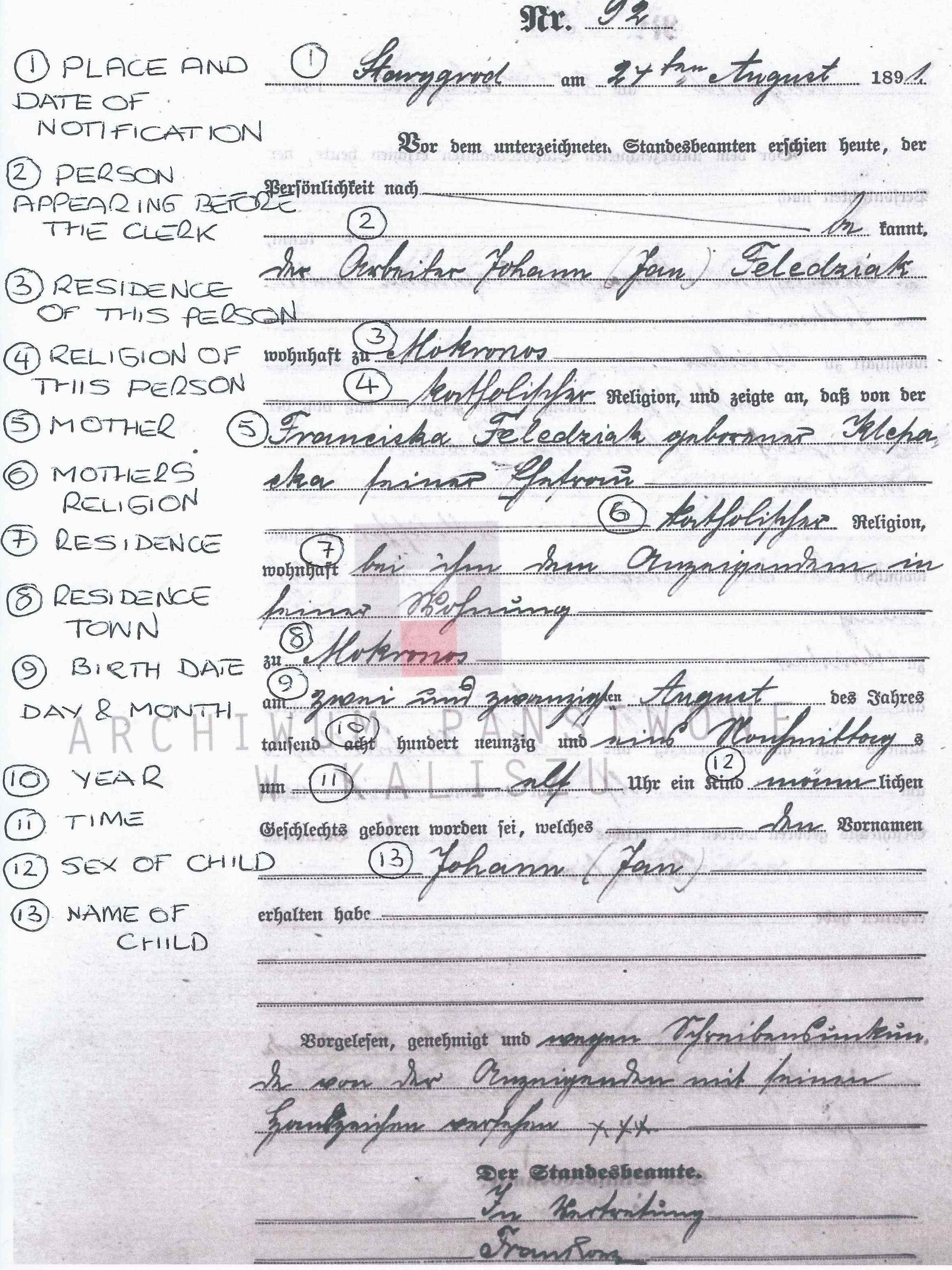
I think this is the Birth Certificate for my Great Uncle Johann Feledziak.
I have added my understanding of what I think the various fields represent but I have little idea of what has been recorded in the various sections.
I can see that the record is for Starygrad and is for 27th August 1891 and it is for Johann ( Jan) Feledziak from Mokronos. His parents are Johann and Franciska Feledziak ( Klepaka ).
Other than that I do not understand much else.
I am very keen to learn the following
what is at item 7 - Residence ?
His birth day at 9 - ?
and any other details
Very Many thanks for looking
Martin Feledziak
| Description: |
|
| Filesize: |
650.69 KB |
| Viewed: |
12616 Time(s) |
|
|
|
|
SophiaPO Top Contributor
Joined: 05 Oct 2014
Replies: 1559
Back to top |
Posted: Sat Aug 15, 2015 1:29 pm
Post subject:
Hi Martin,
I really like your numbering and notes of what the fields mean. Nicely done.
One quick correction for you regarding the date. It is August 24th, not August 27th, 1891. That is the way I read it at the top, in your section 1. If I put together your 9 and 10, it says" "am zwei und zwanstigsten August des Jahres tausend acht hundert neunzig und eins." Which means on the 22nd of August in the year one thousand eight hundred and ninety one (well, that is a little odd, it should have said "eins und neunzig" rather than "neunzig und eins" to mean 91, but it is a pre-printed form so that may explain the unusual order of the words). That "eins" by the way is what I think I see if you look at the letters as they are written in the old German script; see this article: https://en.wikipedia.org/wiki/S%C3%BCtterlin In section 11, it says "um elf Uhr" which means at 11 o'clock. By the way, I am reading the mother's name as Klepacka rather than Klepaka. I know you are interested in section 7 but that will take a bit of work...
Sophia
|
|
|
SophiaPO Top Contributor
Joined: 05 Oct 2014
Replies: 1559
Back to top |
Posted: Sat Aug 15, 2015 1:33 pm
Post subject:
Section 2 says "der Arbeiter Johann (Jan) Feledziak" so he is a worker/laborer.
|
|
|
Martin Feledziak
Joined: 18 Nov 2013
Replies: 29
Location: EnglandBack to top |
Posted: Sun Aug 16, 2015 4:07 am
Post subject:
Greetings Sophia.
Many thanks for you help with my Great Uncle's certificate. It is so wonderful to have an opportunity to find these documents and to the discovery of family history which has been hidden for such a long time.
now with your help I am beginning to find the finer details.
Are all the details written in German Sütterlin, both the preprinted form and the handwritten words recorded by the clerk ?
So Jan was born at 11 o'clock on 22nd August 1891.
Thank you.
Do you have any idea what is recorded at the bottom of the form and what are the three crosses for ?
and yes I am most interested in any detail at item 7.
I am hoping that it indicates a house or street in the village of Mokronas.
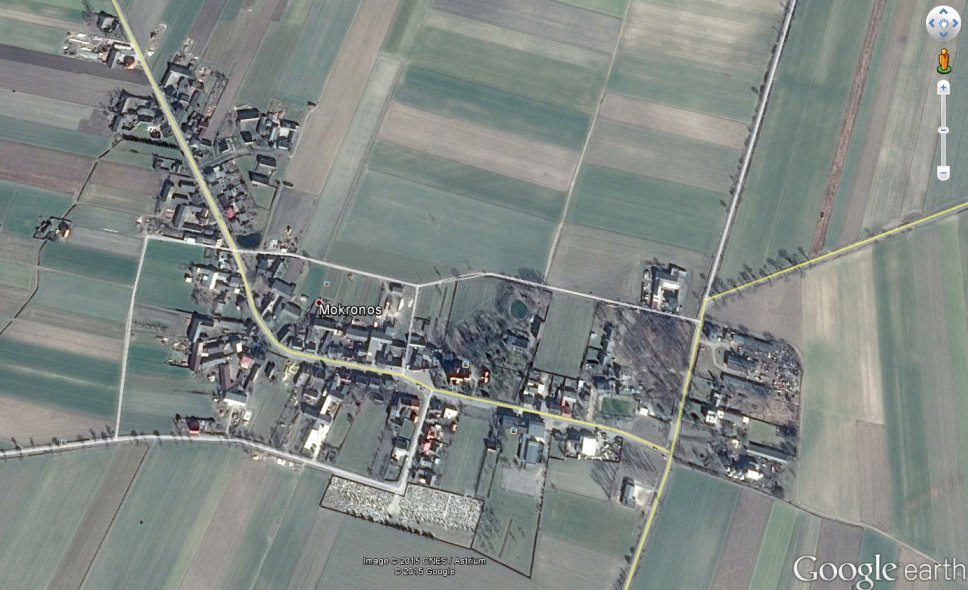
I have added a view of the village just for info.
Does it say what religion they were, were they Catholics ?
Yes so many question I know, but it is very interesting to me.
Best wishes
Martin.
| Description: |
|
| Filesize: |
120.57 KB |
| Viewed: |
12616 Time(s) |
|
|
|
|
UtePO Top Contributor
Joined: 13 Dec 2009
Replies: 599
Location: GermanyBack to top |
Posted: Sun Aug 16, 2015 4:43 am
Post subject:
| Martin Feledziak wrote: | Greetings Sophia.
Many thanks for you help with my Great Uncle's certificate. It is so wonderful to have an opportunity to find these documents and to the discovery of family history which has been hidden for such a long time.
now with your help I am beginning to find the finer details.
Are all the details written in German Sütterlin, both the preprinted form and the handwritten words recorded by the clerk ?
So Jan was born at 11 o'clock on 22nd August 1891.
Thank you.
Do you have any idea what is recorded at the bottom of the form and what are the three crosses for ?
and yes I am most interested in any detail at item 7.
I am hoping that it indicates a house or street in the village of Mokronas.
I have added a view of the village just for info.
Does it say what religion they were, were they Catholics ?
Yes so many question I know, but it is very interesting to me.
Best wishes
Martin. |
Hello Martin,
Re: Do you have any idea what is recorded at the bottom of the form and what are the three crosses for ?
and yes I am most interested in any detail at item 7.
Both parents were Catholic. As for the residence [7 and 8], it says that the wife of the person who appeared in front of the authority to announce the birth resides with him in his apartment in Mokronos.
The crosses at the bottom of the form mean that the announcing person was unable to write. Since he could not write, the form was read to him, agreed on, signed by him with three crosses, and the registrar put in his name at the bottom to confirm the correctness. This was a common practice in those days.
Best,
Ute
|
|
|
Martin Feledziak
Joined: 18 Nov 2013
Replies: 29
Location: EnglandBack to top |
Posted: Sun Aug 16, 2015 5:16 am
Post subject:
Many Thanks Ute,
That appears to answer all of the loose ends on the form.
Best wishes
Martin
|
|
|
SophiaPO Top Contributor
Joined: 05 Oct 2014
Replies: 1559
Back to top |
Posted: Sun Aug 16, 2015 8:35 am
Post subject:
Hi Ute,
I am very glad you answered the remainder of Martin's questions, as it is really beyond my abilities. There have been several people posting questions recently that involve German records, and I have been trying to help as best I can, but there is no substitute for having someone who really knows the language. I would like to ask you, what is the best way of answering the question about what script is being used in these records? I have been pointing people to a link that explains Suetterlin writing, but I have a sense that it is more correct with older records to call the handwriting "old German script" rather than Suetterlin. As for the pre-printed forms that were used, would I be correct to say they are in Fraktur? I can read the Fraktur, but not the old German handwriting or Suetterlin. Are you able to read all of these?
Best regards,
Sophia
-----------------------------------------------
Hi Martin,
I share your interest in all of the old documents that allow us a view into the lives of our ancestors. Best of luck in all your searches!
Sophia
|
|
|
UtePO Top Contributor
Joined: 13 Dec 2009
Replies: 599
Location: GermanyBack to top |
Posted: Mon Aug 17, 2015 12:12 am
Post subject:
Sophia,
I was able to read Martin's record because my German grandmother (born 1887) used this type of old German script. However, I'm not an expert in the different types of old German scripts. I assume you are correct in saying it is 'Suetterlin'.
Best,
Ute
|
|
|
Martin Feledziak
Joined: 18 Nov 2013
Replies: 29
Location: EnglandBack to top |
Posted: Mon Aug 17, 2015 5:46 am
Post subject: Marriage Certificate - Old German Script
Ute and Sophia.
Thank you with your help with Johann's Birth Record.
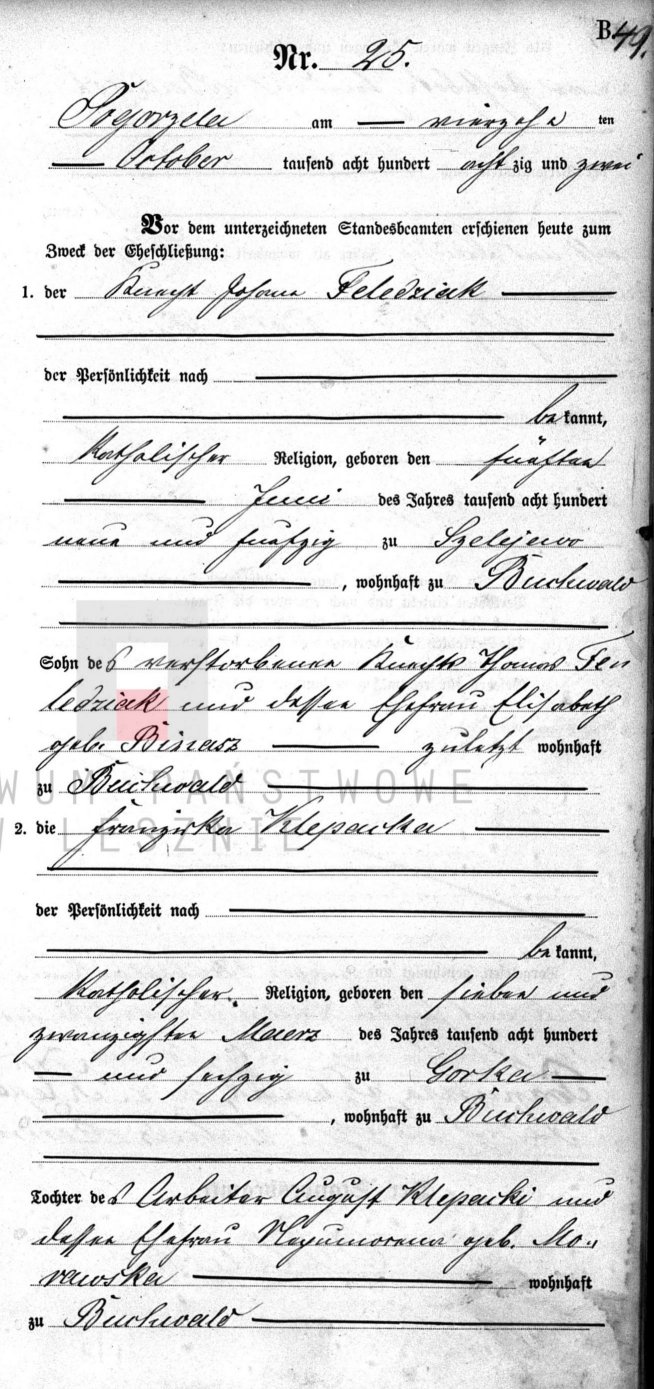
I am unable to let this opportunity pass by without posting the Marriage Certificate of his parents in Pogorzela in 1882
Pogorzela is the next village to Mokronas.
I now ask
Can you see any other details which may be useful to me. I understand just the below names from the certificate.
Johann Feledziak (23 years)
his parents: Thomas Feledziak , Elisabeth Binasz ,
Franziska Klepacka (22 years)
her parents: August Klepacki , Nepomucena Morawska ,
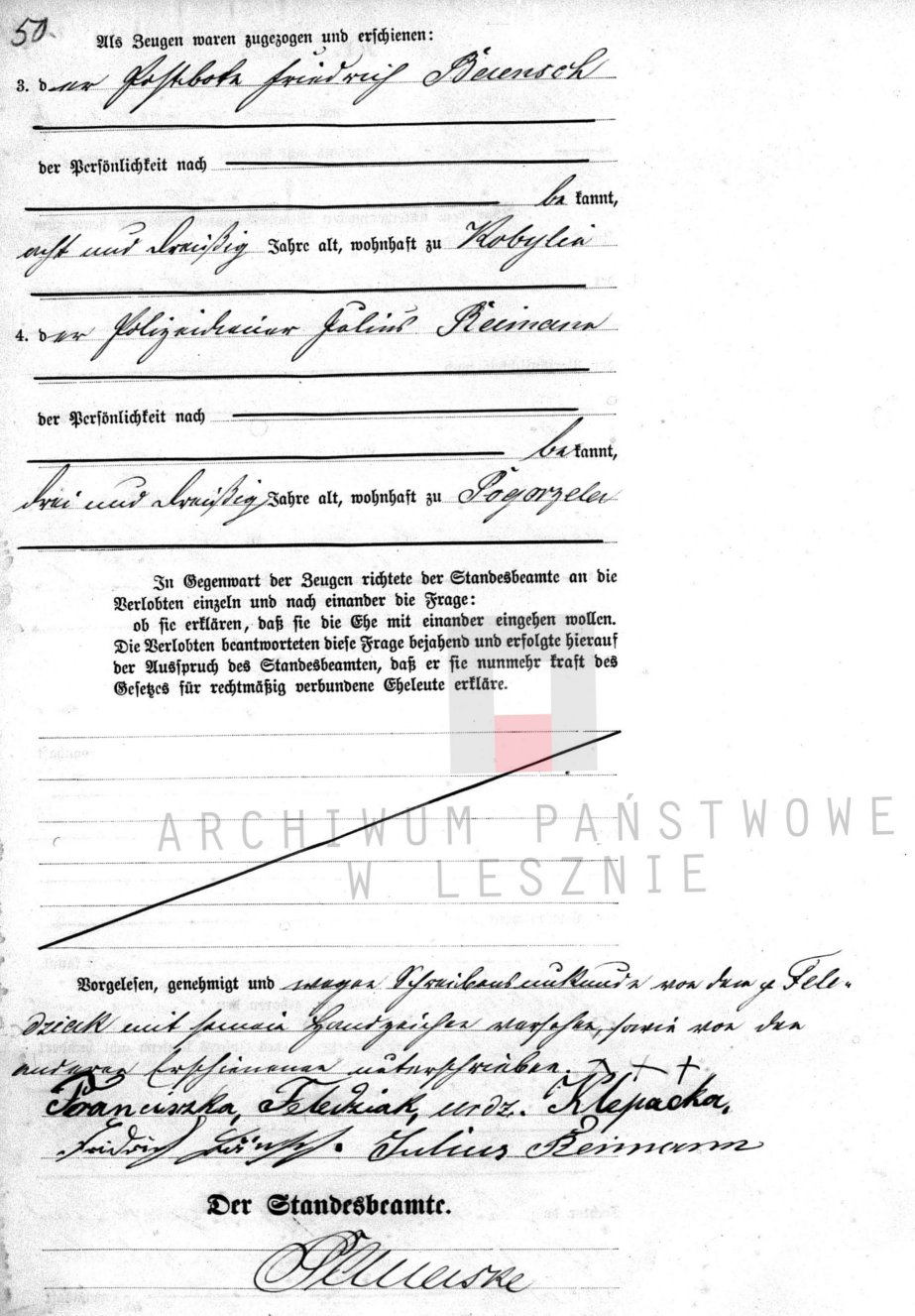
Other people appearing in the document:
Friedrich Baensch
Julius Reimann
Many thanks Martin
| Description: |
|
| Filesize: |
233.39 KB |
| Viewed: |
12620 Time(s) |
|
| Description: |
|
| Filesize: |
221.28 KB |
| Viewed: |
12620 Time(s) |
|
|
|
|
dnowickiPO Top Contributor
Joined: 28 Dec 2011
Replies: 2956
Location: Michigan City, IndianaBack to top |
Posted: Mon Aug 17, 2015 8:18 am
Post subject:
Martin,
A little bit about the history and evolution of civil registration records in the German Partition....Until 1874 there were no free standing civil registry offices. Civil transcripts of parish birth/baptism, marriage, and death records (both Catholic & Protestant) were submitted to the civil government to serve as civil vital records. In 1874 separate civil registry offices were set up and the civil vital records were kept in German on the type of forms you posted. Last year some time, if memory serves, Elzbieta was kind enough to post links to examples of the forms used. I don't remember the links but I downloaded the forms and am attaching them as PDFs. The birth & marriage records provide a Polish translation of the printed German on the forms and the death records contain an English translation of the German. Although that will not help with the handwritten German, it does make the nature of the handwritten entry clear. Perhaps they may be of use to you.
One thing to notice towards the very end of the last page is that the record contains the signature of the bride. Evidently the groom was not able to write since he verified the accuracy of the information read to him by making his mark (XXX).
Also, the location of the registry office is not necessarily the same as the village where the individuals resided nor the place where the marriage ceremony took place. In this case, since the bride and groom were Catholic that would be the Catholic parish to which the village of Mokronas belonged. If the records of the parish to which they belonged have been filmed by the LDS volunteers, it may be useful for you to rent and view the filmed parish records.
Hope this helps you a bit.
Dave
| Description: |
|

Download |
| Filename: |
German-Death-Record-Form-1877.pdf |
| Filesize: |
47.64 KB |
| Downloaded: |
1004 Time(s) |
| Description: |
|
Download |
| Filename: |
German-Death-Record-Form.pdf |
| Filesize: |
35.1 KB |
| Downloaded: |
1127 Time(s) |
| Description: |
|
Download |
| Filename: |
German Marriage Civil Records 1874-1875.pdf |
| Filesize: |
62.32 KB |
| Downloaded: |
727 Time(s) |
| Description: |
|
Download |
| Filename: |
German Civil Birth Records.pdf |
| Filesize: |
61.63 KB |
| Downloaded: |
736 Time(s) |
| Description: |
|
Download |
| Filename: |
German Civil Marriage Reco6rds From 1876.pdf |
| Filesize: |
65.77 KB |
| Downloaded: |
767 Time(s) |
|
|
|
Martin Feledziak
Joined: 18 Nov 2013
Replies: 29
Location: EnglandBack to top |
Posted: Mon Aug 17, 2015 9:23 am
Post subject:
Many Thanks Dave
I have downloaded the forms, most useful. Now that I can see the various formats used in the different records.
I am hoping to find 4 more birth certificates for the other children of Johann ( my 1st Great Grandfather ) and Franziska including one for my Grandfather. I do have his death certificate which is in French.
My Grandfather, Marcin Feledziak, was born into a poor farming community in Wrotkow, Poland on 14th October 1897. He died in 1968 when I was 7, He did not speak anything of the family history and two world wars did so much to disrupt all of the families, so for me Finding family history has been
like trying to do a jig-saw puzzle without any of the pieces and not even the box. Many of the pieces are in very strange language which makes it all the more difficult.
Even if he was prepared to talk 'War stories- and family History' it would have been impossible given that Grandfather spoke, Polish, German and French.
I used English and it was just English for 7 year olds back then.
Now my family elders have all died out so there are no other sources of information, not that they knew much of their own history anyway.
But I keep finding some of these Jig-saw pieces along the way, and perhaps this makes the learning much more rewarding because each piece is a little treasure.
of course they may be entirely the wrong pieces and not even belong to my puzzle.
But with help from forums such as this I have built an interesting family tree. The roots of which date back to the early 1700's and this region of Very Old Poland.
So I keep looking and learning.
Martin
|
|
|
SophiaPO Top Contributor
Joined: 05 Oct 2014
Replies: 1559
Back to top |
Posted: Wed Aug 26, 2015 9:00 am
Post subject:
Hi Martin,
I would like to know whether the keys that Dave provided for you were helpful in deciphering Johann's parents' marriage document. These same kind of translation keys have also been posted on the newly formed German Translations part of the forum. Hopefully they will be useful to many people. Still, it leaves old German script to deal with! I wish I were better able to help with that part.
Best,
Sophia
|
|
|
Martin Feledziak
Joined: 18 Nov 2013
Replies: 29
Location: EnglandBack to top |
Posted: Wed Aug 26, 2015 9:30 am
Post subject:
Greetings Sophia,
I still have trouble working out what the handwritten entries mean in English.
The keys from Dave are handy to show the format and the Death Certificates are most useful because there are English sections to describe the contents.
Martin
|
|
|
SophiaPO Top Contributor
Joined: 05 Oct 2014
Replies: 1559
Back to top |
Posted: Thu Aug 27, 2015 11:20 am
Post subject:
Hi Martin,
I am working my way through the first page.
The certificate is number 25.
The marriage took place in October 1882, and I believe the day was the 19th but I am not totally sure. The words “Vor dem unterzeichneten Standesbeamten erschienen heute zum Zweck der Eheschliessung…” mean “Before the undersigned registrar, there appeared today, for the purpose of marriage….” and first listed is Johann Feledziak. The word before his name would indicate his occupation. I cannot read it; it may begin with a K or an R. Do you know his occupation? The next line indicates that he was catholic. He was born on the 15th of June 1859 in (could it be Szelejewo?) and now resides in (it looks like Buchwald). Then it gives the names of his parents. That's as far as I got at the moment.
May I ask, since you cannot read the writing, how you have such clear note of all of the names in the document?
Best,
Sophia
|
|
|
Martin Feledziak
Joined: 18 Nov 2013
Replies: 29
Location: EnglandBack to top |
Posted: Sat Aug 29, 2015 6:48 am
Post subject:
Greetings Sophia.
I have been using the following web site which provides a search facility for Old Poland/ Prussia.
when I input my surname I get a good number of hits. some results provide just names of the individuals on the record but some link to a scan from the actual record book.
http://www.basia.famula.pl/en/
Obviously I am keen to learn any details from the records but most of the interesting detail is contained in the handwritten entries.
such as you telling me that you can see Szelejewo and Buchwald, which are both little villages, I can see them now you point them out.
Buchwald is a small village which I have seen in many family records so now I am confident that they came from that village.
So many thanks for your observations.
Martin
|
|
|
|
|
|







 FAQ
FAQ Search
 Memberlist
 Profile
 Log in to check your private messages
 Log in
 Register