TedMack
Joined: 12 Jun 2020
Replies: 548
Location: Sydney, AustraliaBack to top |
 Posted: Tue Apr 26, 2022 7:18 am
Post subject: Re: Latin Record Translation
Posted: Tue Apr 26, 2022 7:18 am
Post subject: Re: Latin Record Translation
[quote="dnowicki"] | TedMack wrote: | G'day Dave
A couple more death records I've taken a guess at, plus one with no name that I would be interested in knowing the details, if any. Also from Rychnów parish.
Cheers
Ted |
Hi Ted,
Here are the death records. I believe this concludes the current series.
Dave
Thanks Dave
Ted
|
|
|
TrishPO Top Contributor
Joined: 23 Sep 2020
Replies: 575
Back to top |
Posted: Tue Apr 26, 2022 3:32 pm
Post subject: Translation help please
Hi,
Attached ais the marriage record for my g.g.g. grandfather, Stanislaw Ostrowski.
In the marriage record #1, Stanislaw Ostrowski married Margaretha Marianna Wozniak in Trzemeszno. There is a town is listed under Margaretha Marianna Wozniak's name. Can someone tell me the name of the town? Is this where they are both from?
Thank you!
Trish
| Description: |
|
| Filesize: |
136.85 KB |
| Viewed: |
0 Time(s) |

|
|
|
|
TedMack
Joined: 12 Jun 2020
Replies: 548
Location: Sydney, AustraliaBack to top |
Posted: Wed Apr 27, 2022 1:53 am
Post subject: Latin Record Translation
G'day Dave
Another visit to the FamilySearch Library with success. Still non the wiser as to why the Oleynik family appears in the records as Klimczak (yet their marriage/death records show Oleynik) - not sure if it is an alias or if they are named based on which farm they work at? I note that there are quite a few records for Klimczak's when I was conducting my search.
I found the younger brothers baptism as well as another unknown brother's record. Still need to investigate further as there is at least another brother and maybe the death record for Ewa may shed some light on the name differences.
Can you please translate the attached 2 Baptism records at your leisure.
Cheers
Ted
| Description: |
|
| Filesize: |
211.68 KB |
| Viewed: |
0 Time(s) |

|
| Description: |
|
| Filesize: |
1.12 MB |
| Viewed: |
0 Time(s) |

|
| Description: |
|
| Filesize: |
102.3 KB |
| Viewed: |
0 Time(s) |

|
| Description: |
|
| Filesize: |
1.03 MB |
| Viewed: |
0 Time(s) |

|
|
|
|
TedMack
Joined: 12 Jun 2020
Replies: 548
Location: Sydney, AustraliaBack to top |
Posted: Wed Apr 27, 2022 6:05 am
Post subject: Latin Record Translation
G'day Dave
While I was at FamilySearch I also found a number of records for another family line and these all follow the same standard pattern. I have attempted to translate one and hope I have it correct. There were some areas I had a bit of problem with - those marked with ? and * and was hoping when you have time to correct where I have made an error. I can then use your translation confirmation to translate the others without having to send then through.
Here it goes:-
Translation of B & B record Kucharki Parish:
Col. 1: Numerus = Record Number: 24
Col. 2: Nativitatis = Birth*
Col. 2a: Annis et Mensis = Year & Month: 1860 January
Col. 2b: Dies. = Date: 6th
Col. 2c: Hora. = Hour: 11am
Col. 3: Pueri = Boy
Col. 3a. Legitimi = Legitimate: Checked
Col. 3b: Illegitimi = Illegitimate: Blank
Col. 4: Puellae = Girl
Col. 4a. Legitimi = Legitimate: Blank
Col. 4b: Illegitimi = Illegitimate: Blank
Col. 5: Locus Nativitas = Birth Location* : Karsy
Col. 6: Nomen infantis = Name of Infant (person baptized): Antonius – Antoni
Col. 7: Baptsimi = Baptism Date*
Col. 7a: Annis et Mensis = Year & Month: 1860 January
Col. 7b: Dies. = Date: 12th
Col. 8: Nomen et Cognomen Sacerdotis baptismum administrantis = Person performing Baptism*: X Morkowiski(?)
Col. 9: Nomen et Cognomen = Name of Parents
Col. 9a: Patris = Father: Valentius (Walenty) Kordylasinski
Col. 9b: Matris = Mother: Marianna Solarczyk
Col. 10: Religio = Religion
Col. 10a: Patris = Father: Ditto – Cath?*
Col. 10b: Matris = Mother: Ditto - Cath?*
Col. 11: Conditio Patris = Father Occupation: Lab.??*
Col. 12: Patrinorum. = Godparents
Col. 12a: Nomen et Cognomen : Names? : Lucas Solarczyk and Marianna Bogczyk?
Col. 12b: Conditio = Occupation: Lab.??*
Col. 12c: Locus Habitationis = Godparents residence? : Karsy
Col. 13: Annota………. = Notes.
No hurry - at your leisure.
Cheers
Ted
| Description: |
|
| Filesize: |
113.97 KB |
| Viewed: |
0 Time(s) |

|
|
|
|
dnowickiPO Top Contributor
Joined: 28 Dec 2011
Replies: 2962
Location: Michigan City, IndianaBack to top |
Posted: Thu Apr 28, 2022 4:23 pm
Post subject: Re: Latin Record Translation
| TedMack wrote: | G'day Dave
Another visit to the FamilySearch Library with success. Still non the wiser as to why the Oleynik family appears in the records as Klimczak (yet their marriage/death records show Oleynik) - not sure if it is an alias or if they are named based on which farm they work at? I note that there are quite a few records for Klimczak's when I was conducting my search.
I found the younger brothers baptism as well as another unknown brother's record. Still need to investigate further as there is at least another brother and maybe the death record for Ewa may shed some light on the name differences.
Can you please translate the attached 2 Baptism records at your leisure.
Cheers
Ted |
Hi Ted,
Here are the two baptism records. There is nothing unusual other than the title of the religious who baptized Roch. I’m not positive of the abbreviations of the order of which he was a member but he definitely belonged to one of the branches of the Carmelites. The translations follow.
Dave
B&B of Roch
Top. Kiełczewo Smuzne
In the year of Our Lord 1789 on the 13th day of August I, Brother Eustachy a student from the Convent at Klo??? from Saint Adrian of the Order of Carmelites, baptized an infant by the name of Roch, the son of the legitimate marital union of the industrious* Kazimierz Klimczak and Ewa, The sponsors were the upright** Tomasz Sompolski and Rozalia Anawiezczonka?, a maiden, both from the same village.
Notes: *laboriiosus/industrious: an adjective used to denote an individual as a peasant.
**honestus/upright: The Polish is uczciwy and the adjective usually described a farmer from a small town or a village.
B & B of Jakub
(#20) (Ki)ełczewo Smuzne. On the 29th day of April I baptized an infant by the name of Jakub (born of) the legitimate marital union of the industrious* Kazimierz and Ewa Klimczak, whose sponsors were the upright** Roch Albert (illegible surname) a miller from Kiełczewo and Magdalena, his consort, millers residing in Kiełczewo
Notes: *laboriiosus/industrious: an adjective used to denote an individual as a peasant.
**honestus/upright: The Polish is uczciwy and the adjective usually described a farmer from a small town or a village. However, in this case the sponsor had a trade—a miller.
|
|
|
dnowickiPO Top Contributor
Joined: 28 Dec 2011
Replies: 2962
Location: Michigan City, IndianaBack to top |
Posted: Fri Apr 29, 2022 7:02 am
Post subject: Re: Latin Record Translation
| TedMack wrote: | G'day Dave
While I was at FamilySearch I also found a number of records for another family line and these all follow the same standard pattern. I have attempted to translate one and hope I have it correct. There were some areas I had a bit of problem with - those marked with ? and * and was hoping when you have time to correct where I have made an error. I can then use your translation confirmation to translate the others without having to send then through.
Here it goes:-
Translation of B & B record Kucharki Parish:
Col. 1: Numerus = Record Number: 24
Col. 2: Nativitatis = Birth*
Col. 2a: Annis et Mensis = Year & Month: 1860 January
Col. 2b: Dies. = Date: 6th
Col. 2c: Hora. = Hour: 11am
Col. 3: Pueri = Boy
Col. 3a. Legitimi = Legitimate: Checked
Col. 3b: Illegitimi = Illegitimate: Blank
Col. 4: Puellae = Girl
Col. 4a. Legitimi = Legitimate: Blank
Col. 4b: Illegitimi = Illegitimate: Blank
Col. 5: Locus Nativitas = Birth Location* : Karsy
Col. 6: Nomen infantis = Name of Infant (person baptized): Antonius – Antoni
Col. 7: Baptsimi = Baptism Date*
Col. 7a: Annis et Mensis = Year & Month: 1860 January
Col. 7b: Dies. = Date: 12th
Col. 8: Nomen et Cognomen Sacerdotis baptismum administrantis = Person performing Baptism*: X Morkowiski(?)
Col. 9: Nomen et Cognomen = Name of Parents
Col. 9a: Patris = Father: Valentius (Walenty) Kordylasinski
Col. 9b: Matris = Mother: Marianna Solarczyk
Col. 10: Religio = Religion
Col. 10a: Patris = Father: Ditto – Cath?*
Col. 10b: Matris = Mother: Ditto - Cath?*
Col. 11: Conditio Patris = Father Occupation: Lab.??*
Col. 12: Patrinorum. = Godparents
Col. 12a: Nomen et Cognomen : Names? : Lucas Solarczyk and Marianna Bogczyk?
Col. 12b: Conditio = Occupation: Lab.??*
Col. 12c: Locus Habitationis = Godparents residence? : Karsy
Col. 13: Annota………. = Notes.
No hurry - at your leisure.
Cheers
Ted |
Hi Ted,
You did well with the translation of the columnar format record. The errors are pretty much confined to the transcription & translation of the headings and they revolve around the translation of the case endings. It seems that Genitives gave you difficulties. The usual way to translate a Genitive is by using the English preposition “of”. The heading “Nativitatis” is thus translated as “of birth”. I suppose that some confusion can arise from the fact that certain endings are shared by more than one case within a given declension. The way to tell the difference is found in the sense of the text.
Here is the reformed version of the template you used:
Col. 1: Numerus = Number (in sequence for the year):
Col 2: Nativitatis = Of Birth
Col.2a: Annus et mensis = Year and month:
Col. 2b: Dies = Day:
Col. 2c: Hora = Hour:
Col. 3: Pueri = Boys
Col. 3a: Legitimi = Legitimate:
Col. 3b: Illegitimi = Illegitimate:
Col. 4: Puellae = Girls
Col. 4a: Legitimae = Legitimate:
Col. 4b: Illegitimae = Illegitimate:
Col. 5: Locus Nativitatis = Place of Birth:
Col. 6: Nomen Infantis = Name of the Child
Col. 6a: Baptismi = Of the Baptism
Col. 6a1: Annus et Mensis = The Year and Month:
Col. 6a2: Dies = Day:
Col. 7: Nomen et Cognomen Sacerdotis baptismum administrantis = The Given and the Surname of the Priest administering the baptism:
Col. 8: Nomen et Cognomen = The Given and the Surname
Col. 8a: Patris = Of the Father:
Col. 8b: Matris = Of the Mother:
Col. 9: Religio = The Religion
Col. 9a: Patris = Of the Father: Catholic
Col. 9b: Matris = Of the Mother: Catholic
Col. 10: Conditio Patris = The condition/status of the Father:
Col. 11: Patrinorum = Of the Sponsors
Col. 11a: Nomen et Cognomen = The Given and the Surname:
Col. 11b: Conditio = (Their) condition/status:
Col. 11c: Locus habitationis = Place of residence:
Col. 12: Adnotationes utrum gemelli Seu quid aliud notatu necessarium = Notations: whether twins Or something else which need be noted:
On to the asterisks… Col.2: Nativitatis = Of Birth; Cols. 3 & 4: pueri and puellae are Nominative Plurals and are translated as “boys” & “girls” rather than “boy” & “girl”; Col.5: locus nativitatis is translated as “place of birth”; Col. 8: the X before the surname of the priest is actually Polish and stands for Ksiądz (“priest”). Traditionally the title for a secular/diocesan priest is Ksiądz whereas the title for a priest who belonged to a religious order is Ojciec (Father). The Latin terms Nomen and Cognomen are first/given name and surname/last name; Cols. 10A & b: Yes, both are Catholic; the abbreviation “lab” in Cols. 11 & 12b in theory could stand for either laboriosus/industrious or for laborator/worker/laborer. Prior to the emancipation of of the peasants in German controlled Poland in 1806 it would definitely stand for laboriosus/industrious. However, after that year it almost certainly stands for laborator/worker/laborer.
The given name “Lucas” is the Latin form of Łukasz (Polish) Luke (English). Biblical and Greek names which were imported into Latin belong to the 1st Declension but their Nominative Singular has the ending “as” rather than “a” as is found in most 1st Declension names. If you use the list of given names which I’ll post here as a PDF you should be able to determine the Polish (& English) version of just about every Latin name you come across. Ever since I first offered to provide translations from Latin I considered the goal of this thread not to simply be a free translation service but to be a way to provide members of the forum with the tools and help which would allow them to eventually become self sufficient in dealing with Latin records—something which flows from the years I spent teaching Latin. The list of names is one of those tools.
I’ve never been big on repetitive typing so I compiled fill in the blanks templates for columnar birth, marriage, and death records. If you should come upon a record which you want to translate yourself just post the headings and I’ll post the template which corresponds to those headings, which should make it faster and easier for you to fill in the blanks.
Keep up the good work and someday you should be able to carry on a full conversation with a long dead Roman.
Dave
| Description: |
|

Download |
| Filename: |
GIVEN NAMES-LATIN, ENGLISH, POLISH 2022 March 14.pdf |
| Filesize: |
74.77 KB |
| Downloaded: |
310 Time(s) |
|
|
|
TedMack
Joined: 12 Jun 2020
Replies: 548
Location: Sydney, AustraliaBack to top |
Posted: Fri Apr 29, 2022 8:10 am
Post subject: Re: Latin Record Translation
Dave
Thanks for this - you learn something new everyday - I didn't know that X is short for Ksiądz. In regards to speaking with long dead Romans, I get that feeling sometimes when I speak to my kids!
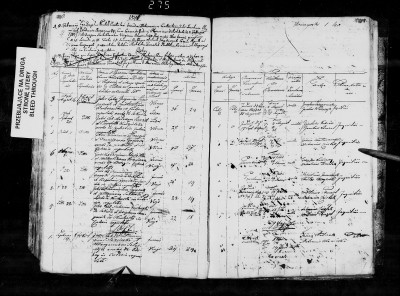
I have the attached Marriage record - last one in 1847 where I can't read the scrawl of the transcriber and being in Latin also does not assist. I know it is for my GGGrandparents Walenty Kordylas and Marianne Solarczyk but other than that it is difficult for me to decipher - not sure how to post just the the headings, so I've attached the whole document. When you get a chance if you could review that would be great.
Cheers
Ted
| Description: |
|
| Filesize: |
1.26 MB |
| Viewed: |
0 Time(s) |
|
|
|
|
dnowickiPO Top Contributor
Joined: 28 Dec 2011
Replies: 2962
Location: Michigan City, IndianaBack to top |
Posted: Fri Apr 29, 2022 8:55 pm
Post subject: Re: Latin Record Translation
| TedMack wrote: | Dave
Thanks for this - you learn something new everyday - I didn't know that X is short for Ksiądz. In regards to speaking with long dead Romans, I get that feeling sometimes when I speak to my kids!
I have the attached Marriage record - last one in 1847 where I can't read the scrawl of the transcriber and being in Latin also does not assist. I know it is for my GGGrandparents Walenty Kordylas and Marianne Solarczyk but other than that it is difficult for me to decipher - not sure how to post just the the headings, so I've attached the whole document. When you get a chance if you could review that would be great.
Cheers
Ted |
Hi Ted,
The handwriting is not the clearest or the most elegant and then the bleed through doesn’t help. Here is the template should you encounter another marriage record which uses the same headings.
Col. 1: Numerus = Number (for the year):
Col. 2: Annus et Dies Copulationis = Year and Day of the Marriage:
Col. 3: Nomen Scerdotis Copulantis = Name of the Priest Joining (the Couple):
Col. 4: Nomen et Cognomen Copulatorum, locus habitationis, conditio et professio et utrum copulatio in ecclesia vel in aedibus privatis subsecuta est = The first and surnames of those marrying, (their) place of residence, condition/status/occupation and profession and whether the marriage followed in a church or in private building:
Col. 5: Utrum in matrimonio jam vixere nec non utrum sub tutela parentum vel tutorum adhoc existant = Whether they (i.e. the contracting parties) have already lived in marriage (i.e. whether one or both had been married previously) or if not whether to this point they lived under the charge of their parents or guardians:
Col. 6: Aetas = Age
Col. 6a: Sponsi = Of the Groom:
Col. 6b: Sponsae = Of the Bride:
Col. 7: Religio = Religion
Col. 7a: Sponsi = Of the Groom:
Col. 7b: Sponsae = Of the Bride:
Col. 8: Consensus Parentum vel Tutorum = The Consent of the Parents or the Guardians:
Col. 9: Proclamatio Banorum = Announcement of the Banns:
Col. 10: Dispensatio a proclamationibus = Dispensation from the announcements (of the banns):
Col. 11: Testes = Witnesses:
Col. 12: Adnotationes = Notations:
Here follows the template with the data from this marriage entered. I’m not certain of my reading of some of the Arabic numerals.
Wishing you continued success,
Dave
Col. 1: Numerus = Number (for the year): 1847 #1
Col. 2: Annus et Dies Copulationis = Year and Day of the Marriage: September 19, 1847
Col. 3: Nomen Scerdotis Copulantis = Name of the Priest Joining (the Couple): Hitrl (?)
Col. 4: Nomen et Cognomen Copulatorum, locus habitationis, conditio et professio et utrum copulatio in ecclesia vel in aedibus privatis subsecuta est = The first and surnames of those marrying, (their) place of residence, condition/status/occupation and profession and whether the marriage followed in a church or in private building: Between the peasant/worker Walenty Kordilasinski and Maryanna Solarczyk, both from Bobry(?), married in the church.
Col. 5: Utrum in matrimonio jam vixere nec non utrum sub tutela parentum vel tutorum adhoc existant = Whether they (i.e. the contracting parties) have already lived in marriage (i.e. whether one or both had been married previously) or if not whether to this point they lived under the charge of their parents or guardians: a bachelor (&) a maiden
Col. 6: Aetas = Age
Col. 6a: Sponsi = Of the Groom: 24 (?)
Col. 6b: Sponsae = Of the Bride: 24 (?)
Col. 7: Religio = Religion
Col. 7a: Sponsi = Of the Groom: Catholic
Col. 7b: Sponsae = Of the Bride: Catholic
Col. 8: Consensus Parentum vel Tutorum = The Consent of the Parents or the Guardians: With the consent of the parents.
Col. 9: Proclamatio Banorum = Announcement of the Banns: 1st September 5(?); 2nd September 12; 3rd September 19
Col. 10: Dispensatio a proclamationibus = Dispensation from the announcements (of the banns): None (nulla)
Col. 11: Testes = Witnesses: Franz Antczak; Antoni WisnieskiCol. 12: Adnotationes = Notations: Ditto = inquilini = tenants
|
|
|
TedMack
Joined: 12 Jun 2020
Replies: 548
Location: Sydney, AustraliaBack to top |
Posted: Sat Apr 30, 2022 8:04 am
Post subject: Latin Record Translation
Thanks Dave
So easy when you know how. The place "Bobry" no longer exists under this name in the Kucharki Parish (or at least I can't locate it). Not sure if it was the name for Karsy (aka Bismarksdorf) when under the Grand Duchy of Posen in the 1840's as their children were all born in Karsy and they both died in Karsy many years later.
Cheers
Ted
PS. I did a further search in http://www.kartenmeister.com/ and found details as
German Name Bobry
Polish/Russian Name Karsy
Kreis/County Pleschen
German Province Posen
Today's Province Wielkopolskie
Location East 17°53' North 51°48'
Google Map Google Maps (Bobry)
Map Number 81
Location Description This village/town is located 2.7 km and 34 degrees from Sobotka, which is known today as Sobotka
Lutheran Parish D
Remarks For additional information see: Bismarcksdorf
|
|
|
dnowickiPO Top Contributor
Joined: 28 Dec 2011
Replies: 2962
Location: Michigan City, IndianaBack to top |
Posted: Sat Apr 30, 2022 10:04 am
Post subject: Re: Latin Record Translation
[quote="TedMack"]Thanks Dave
So easy when you know how. The place "Bobry" no longer exists under this name in the Kucharki Parish (or at least I can't locate it). Not sure if it was the name for Karsy (aka Bismarksdorf) when under the Grand Duchy of Posen in the 1840's as their children were all born in Karsy and they both died in Karsy many years later.
Cheers
Ted
PS. I did a further search in http://www.kartenmeister.com/ and found details as
German Name Bobry
Polish/Russian Name Karsy
Kreis/County Pleschen
German Province Posen
Today's Province Wielkopolskie
Location East 17°53' North 51°48'
Hi Ted,
A rather handy map to use is David Gilly’s 1803 map of South Prussia. I’ve found it useful for a number of reasons, not the least of which is that it paints a good picture of the land conditions and use for that period. Since the majority of my ancestors were from the województwa of the Polish-Lithuanian Commonwealth which were seized by Prussia during the Partitions their villages appear on the Gilly Map.
Bobry and Karsy adjoin each other and can be found at the top of Section B3 of the map. An easy point of reference is that they can be found just to the left of the number 3 at the top of the image. Perhaps since they were adjacent to each other they may have merged under the name Karsy by the middle of the 19th Century—especially since only Karsy and not Bobry is listed in the Słownik geograficzny.
Here is the link to the Gilly Map: https://www.sggee.org/research/gilly_maps/south_prussia_map.html
Here is a link to Karsy in the Słownik geograficzny http://dir.icm.edu.pl/pl/Slownik_geograficzny/Tom_III/881
I hope that you find the map useful.
Dave
|
|
|
Posted: Sun May 01, 2022 9:56 am
Post subject: Apos? following birth name
Hi Dave,
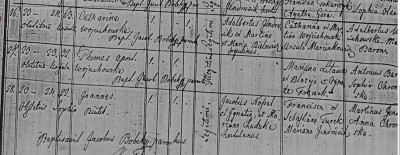
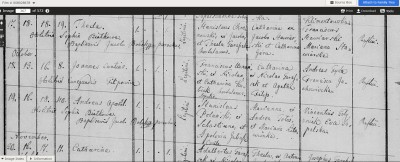
Another one for your scholarly mind. Can you tell me what the apos/apol? following first names in some birth certificates signifies? I am guessing different abbreviations for the same word. I understand the rest of the records.
Record 27 for Thomas aspol. Litawa on "Kruzlowa 1862 Litawa thom"
Record 19 for Andreas apos?ol Polanski on "Krużlowa 1857 Polanski andreas scan 367"
As always thanks so much,
Malu
| Description: |
|
| Filesize: |
849.36 KB |
| Viewed: |
0 Time(s) |
|
| Description: |
|
| Filesize: |
275.4 KB |
| Viewed: |
0 Time(s) |
|
|
|
|
dnowickiPO Top Contributor
Joined: 28 Dec 2011
Replies: 2962
Location: Michigan City, IndianaBack to top |
Posted: Sun May 01, 2022 12:09 pm
Post subject: Re: Apos? following birth name
| MPolanski wrote: | Hi Dave,
Another one for your scholarly mind. Can you tell me what the apos/apol? following first names in some birth certificates signifies? I am guessing different abbreviations for the same word. I understand the rest of the records.
Record 27 for Thomas aspol. Litawa on "Kruzlowa 1862 Litawa thom"
Record 19 for Andreas apos?ol Polanski on "Krużlowa 1857 Polanski andreas scan 367"
As always thanks so much,
Malu |
Hi Malu,
You are correct that both abbreviations are for the same word, apostolus, apostoli, m. apostle. The priest was specifying the saint after whom the children were named, St. Andrew the Apostle and St. Thomas the Apostle. Since Name Days were celebrated rather than birthdays he wanted the parents to know which St. Andrew and which St. Thomas was the child’s patron saint. There were quite a few saints named Andrew and Thomas. If you look at the entry above the entry for Andrew the child was named Joannes Cantius or John Cantius (English) or Jan Kanty (Polish). Again, this specifies which of the many saints named John was his patron saint. In everyday life, of course, the individuals were simply known as Andrzej, Tomasz, and Jan. I believe that more often than not it was the priest who did the choosing of the specific saint who became the person’s patron saint since the priest would have been much more familiar with the liturgical calendar than the parents. Often, but not always, the patron saint chosen was the saint whose feast day was fairly close to the day the child was baptized.
I hope the long answer to a simple question helps your future research.
Dave
|
|
|
Posted: Sun May 01, 2022 7:24 pm
Post subject: Re: Apos? following birth name
| dnowicki wrote: | | MPolanski wrote: | Hi Dave,
Another one for your scholarly mind. Can you tell me what the apos/apol? following first names in some birth certificates signifies? I am guessing different abbreviations for the same word. I understand the rest of the records.
Record 27 for Thomas aspol. Litawa on "Kruzlowa 1862 Litawa thom"
Record 19 for Andreas apos?ol Polanski on "Krużlowa 1857 Polanski andreas scan 367"
As always thanks so much,
Malu |
Hi Malu,
You are correct that both abbreviations are for the same word, apostolus, apostoli, m. apostle. The priest was specifying the saint after whom the children were named, St. Andrew the Apostle and St. Thomas the Apostle. Since Name Days were celebrated rather than birthdays he wanted the parents to know which St. Andrew and which St. Thomas was the child’s patron saint. There were quite a few saints named Andrew and Thomas. If you look at the entry above the entry for Andrew the child was named Joannes Cantius or John Cantius (English) or Jan Kanty (Polish). Again, this specifies which of the many saints named John was his patron saint. In everyday life, of course, the individuals were simply known as Andrzej, Tomasz, and Jan. I believe that more often than not it was the priest who did the choosing of the specific saint who became the person’s patron saint since the priest would have been much more familiar with the liturgical calendar than the parents. Often, but not always, the patron saint chosen was the saint whose feast day was fairly close to the day the child was baptized.
I hope the long answer to a simple question helps your future research.
Dave |
Thanks Dave. Love long answers. You possess such a treasure trove of information. I can't imagine learning about all of this somewhere else. I've seen a few of these but thought they were middle names. Makes so much sense after you explain it. I knew they had, and celebrated saint days. I didn't realize I had some specific examples. For Andrew the priest seems to have skipped over Saint Andrew Avellino. Andrew was born the 16th of October. Andrew Avellino's saint day is November 10th, whereas St Andrew the Apostle's feast day is Nov 30. Fascinating information.
Am I correct that if this would have been written out it would use the nominative form?
Malu
|
|
|
TedMack
Joined: 12 Jun 2020
Replies: 548
Location: Sydney, AustraliaBack to top |
Posted: Mon May 02, 2022 4:48 am
Post subject: Latin Record Translation
Thanks Dave,
That Gilly Map has already come in handy as it explains the term "Hollendry" which I've seen when searching for Walenty's birth record in Burocin.
Cheers
Ted
|
|
|
dnowickiPO Top Contributor
Joined: 28 Dec 2011
Replies: 2962
Location: Michigan City, IndianaBack to top |
Posted: Mon May 02, 2022 11:34 pm
Post subject: Re: Apos? following birth name
| MPolanski wrote: | | dnowicki wrote: | | MPolanski wrote: | Hi Dave,
Another one for your scholarly mind. Can you tell me what the apos/apol? following first names in some birth certificates signifies? I am guessing different abbreviations for the same word. I understand the rest of the records.
Record 27 for Thomas aspol. Litawa on "Kruzlowa 1862 Litawa thom"
Record 19 for Andreas apos?ol Polanski on "Krużlowa 1857 Polanski andreas scan 367"
As always thanks so much,
Malu |
Hi Malu,
You are correct that both abbreviations are for the same word, apostolus, apostoli, m. apostle. The priest was specifying the saint after whom the children were named, St. Andrew the Apostle and St. Thomas the Apostle. Since Name Days were celebrated rather than birthdays he wanted the parents to know which St. Andrew and which St. Thomas was the child’s patron saint. There were quite a few saints named Andrew and Thomas. If you look at the entry above the entry for Andrew the child was named Joannes Cantius or John Cantius (English) or Jan Kanty (Polish). Again, this specifies which of the many saints named John was his patron saint. In everyday life, of course, the individuals were simply known as Andrzej, Tomasz, and Jan. I believe that more often than not it was the priest who did the choosing of the specific saint who became the person’s patron saint since the priest would have been much more familiar with the liturgical calendar than the parents. Often, but not always, the patron saint chosen was the saint whose feast day was fairly close to the day the child was baptized.
I hope the long answer to a simple question helps your future research.
Dave |
Thanks Dave. Love long answers. You possess such a treasure trove of information. I can't imagine learning about all of this somewhere else. I've seen a few of these but thought they were middle names. Makes so much sense after you explain it. I knew they had, and celebrated saint days. I didn't realize I had some specific examples. For Andrew the priest seems to have skipped over Saint Andrew Avellino. Andrew was born the 16th of October. Andrew Avellino's saint day is November 10th, whereas St Andrew the Apostle's feast day is Nov 30. Fascinating information.
Am I correct that if this would have been written out it would use the nominative form?
Malu |
Hi Malu,
You are correct that the full form of the abbreviation would be in the Nominative Case, apostolus. The grammatical reason is that it stands in apposition with the name Andreas or the name Thomas, both of which are in the Nominative.
The priest may not have past over Andrew Avellino in favor of Andrew the Apostle. During the 19th Century and until the liturgical calendar reforms post Vatican II the calendar was almost overwhelmed with a plethora of saints days, some well known and others extremely obscure. Some, like the apostles, had feast days which were observed by the entire Catholic Church whereas others barely rated an “honorable mention” in the general calendar. Each diocese published a book known as an “Ordo” which spelled out which saints were celebrated and how they were to be remembered liturgically. Some were “universal”, others were “national” and some were limited to a diocese. (I know this because when I was an altar boy in 8th grade the priest who had been pastor of our parish for 45 years was no longer healthy enough to celebrate Mass in Church. My best grammar school friend, Marty, and I took turns serving the pastor’s Mass in the rectory. One of our duties was to consult the Ordo to make sure that the proper color vestments were set out and that the missal was set to the proper pages. This all took place just prior to the liturgical calendar reforms. (One major perk was that the nun never knew when Msgr. had finished Mass which enabled us to avoid some of the boredom of sitting in class all morning. A favorite trick was to come to class and sit down for 15 minutes and then leave to serve at a funeral. The standard answers to where have you been and where are you going were “Serving for Msgr.” and “Going to serve a funeral.”) Anyway, Andrew Avellino was a minor league player—venerated mainly in Naples—as opposed to Andrew the Apostle who one of the top major league players. The Ordo the priest was using in Galicia during the middle of the 19th Century may not have had any mention of Andrew Avellino whereas Andrew the Apostle would have been listed in bold print and all in caps.
I don’t believe that my lack of enthusiasm for 8th grade hurt me in the long run.
So much for another long answer to a short question.
Dave
|
|
|
|
|
|











 FAQ
FAQ Search
 Memberlist
 Profile
 Log in to check your private messages
 Log in
 Register