gmwade8
Joined: 30 Dec 2025
Replies: 5
Location: USABack to top |
 Posted: Mon Feb 16, 2026 10:43 am
Post subject: Birth and marriage
Posted: Mon Feb 16, 2026 10:43 am
Post subject: Birth and marriage
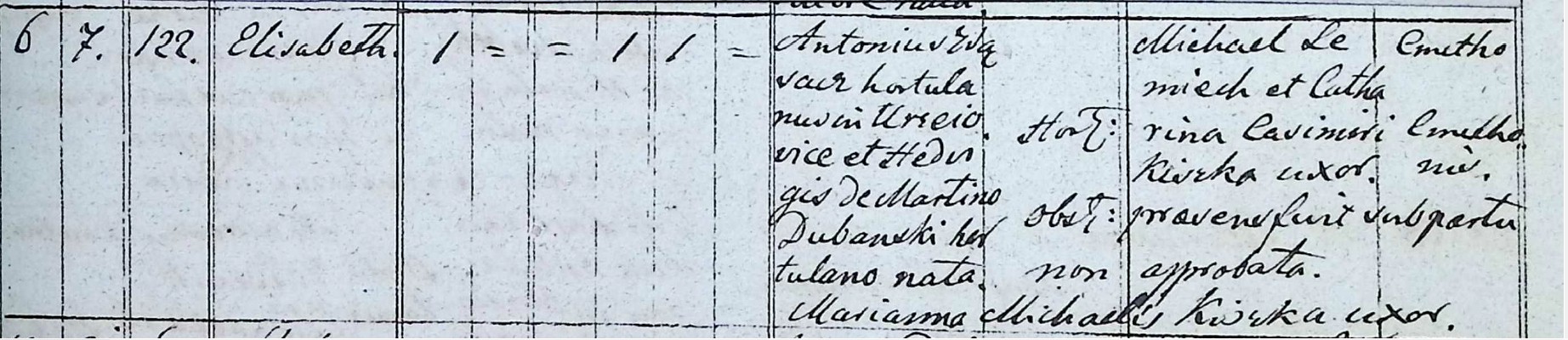
I need help with some missing pieces of the birth and marriage records of Elizabeth. Here is my translation so far:
BIRTH RECORD (Nov 6, 1841)
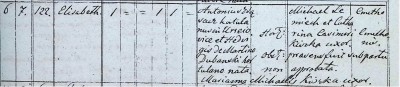
Elizabeth (father Antonio Wąsacz), gardener, from Urzejowice and (mother Hedvigis from Martino Dubanski, gardener). House number was #122
Who is Marianna, wife of Michael Kiszka? How is she related?
Sponsors: Michael Lemiech and Catherine (wife of Casmir Kiszka), farmers.
What is provens fuit subpartu non approbata for obstetrics?
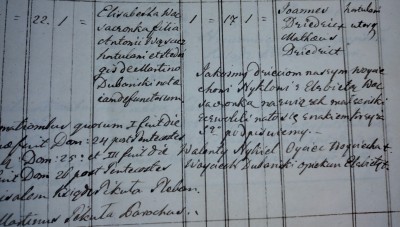
MARRIAGE RECORD (Nov 2, 1858) shows same parents. Was her mother Hedvigis deceased? It appears that her guardian was Wojciech Dubanski and house number was changed #145
| Description: |
|
| Filesize: |
319.4 KB |
| Viewed: |
5 Time(s) |
|
| Description: |
|
| Filesize: |
226.7 KB |
| Viewed: |
0 Time(s) |
|
|
|
|
Posted: Mon Feb 16, 2026 1:56 pm
Post subject:
The marriage entry of Elizabeth's parentage reads "Elisabeth Wąsaczonka daughter of hortulanus/gardener Antoni Wąsacz and Hedvigis born of Martin Dubański now deceased" either Hedvig or her father Martin was deceased by 1858.
The obstetrix latin seems to read praesens fuit subpartu non approbata and seems like a note on the legality of the birth and/or baptism although I do not know what it specifically implied within the church. There is no clear context given to definitively determine how Marianna and her hudband Michael Kiszka were related to Wąsacz, unless Marianna was the obstetrix.
|
|
|
gmwade8
Joined: 30 Dec 2025
Replies: 5
Location: USABack to top |
Posted: Mon Feb 16, 2026 9:13 pm
Post subject:
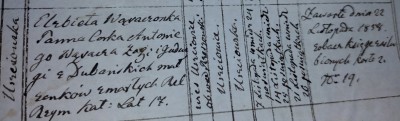
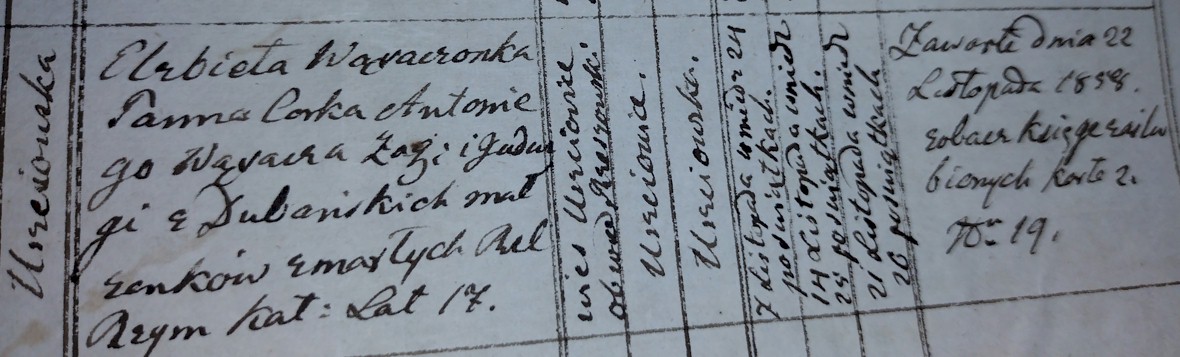
I have Elzbieta's Banns of Marriage. Do the banns of marriage (in Polish) clarify who is deceased at the time of her marriage? One or both parents?
| Description: |
|
| Filesize: |
124.5 KB |
| Viewed: |
0 Time(s) |
|
|
|
|
dnowickiPO Top Contributor
Joined: 28 Dec 2011
Replies: 2959
Location: Michigan City, IndianaBack to top |
Posted: Mon Feb 16, 2026 9:50 pm
Post subject:
| gmwade8 wrote: | | I have Elzbieta's Banns of Marriage. Do the banns of marriage (in Polish) clarify who is deceased at the time of her marriage? One or both parents? |
Salvete (Greetings),
Before I comment on the information in the records perhaps a few remarks may help to clarify a some points regarding Latin records from Galicia. Although these records were used by the parish priests during the 19th century and a copy of the records was housed in the parish office the metrical books are not ecclesiastical records per se, but are civil records masquerading as ecclesiastical records. Parish priests were tasked with acting as civil registrars. Since multiple copies were needed the parish priest usually hired someone who had a modicum of Latin knowledge to do the busy work of producing the required copies.
Since Franz Joseph I was Emperor of Austria, King of Hungary, and the ruler of the other states of the Habsburg monarchy from December 2, 1848 until his death in 1916 the records you posted were created during his reign and much of their format and content were mandated by him. He came to power during the revolutionary period commonly known as “The Springtime of the Peoples”. Although he reluctantly made some concessions and modifications to policies of his absolute monarchy he was a reactionary who seemed to be mainly interested in protecting the House of Habsburg from morganatic marriages like the marriage between his heir apparent Archduke Franz Ferdinand to Sophie Countess of Chotek. Franz Joseph did allow one significant change, the emancipation of the peasants from their feudal obligations, which had a lasting impact throughout the remaining history of the Empire. (The Austrian, the German and the Russian Empire all ended with the end of WWI.
Since the Austrian Empire was a multi-ethnic state with no common language the Empress Maria Theresa chose Latin as the language to be used for the keeping of vital records when Austria seized the southern lands of the Polish-Lithuanian Commonwealth during the First Partition of Poland in 1772. The Commonwealth was formally known as The Kingdom of Poland and the Grand Duchy of Lithuania (Polish: Królestwo Polskie i Wielkie Księstwo Litewskie; Latin: Regnum Poloniae Magnusque Ducatus Lithuaniae). When Austria seized and ruled the region the area was known as the Kingdom of Galicia and Lodomeria from 1772 until after the end of WWI when it became part of the Second Polish Republic. After WWII eastern Galicia became part of Ukraine. Although online records from the region seem to exist only after 1772, sacramental records were mandated by the Council of Trent in 1575 and in other regions of Poland date from about 1600 when the decrees of the Council were implemented in northern and eastern Europe.
Since Franz Joseph I was Emperor of Austria, King of Hungary, and the ruler of the other states of the Habsburg monarchy from December 2, 1848 until his death in 1916 the records you posted were created during his reign and much of their format and content were mandated by him. He came to power during the revolutionary period commonly known as “The Springtime of the Peoples”. Although he reluctantly made some concessions and modifications to policies of his absolute monarchy he was a reactionary who seemed to be mainly interested in protecting the House of Habsburg from morganatic marriages like the marriage between his heir apparent Archduke Franz Ferdinand to Sophie Countess of Chotek. Franz Joseph did allow one significant change, the emancipation of the peasants from their feudal obligations, which had a lasting impact throughout the remaining history of the Empire.
The birth of Elżbieta took place before the emancipation of the peasants from their feudal obligations and although her marriage took place ten years after the emancipation of the peasantry, the old feudal vocabulary still often appeared in records. Remember that Franz Joseph was conservative reactionary so it is no surprise that the old vocabulary was still in use. Everyone who appears in the marriage and B&B records with the exception of the male sponsor and the husband of the female sponsor (who were cmethones) were hortulani which was the third level below the highest level in the hierarchy of peasantry (cmetho). This vocabulary is descriptive of the amount of land a peasant farmer held and worked.
Cmethones held enough land to be self-sustaining and they often hired other peasants to work for them. A hortulanus was not some sort of person employed to care for another person’s garden. The term meant that a hortulanus had a cottage and enough land for a garden, but no farm fields.
To the records...Case endings matter in Latin if one is to properly understand the record. Given names need to be translated to the vernacular, which in this instance is Polish. It is most unlikely that the individuals in records had even the slightest idea of what their name was in Latin. Attached please fid a PDF of ommon Latin given names with their Polish and English versions.
Birth rercord: Jadwiga (Hedwigis) was the daughter of Marcin (Martin) Dubanski.
The midwife (obstetrix) was present at the birth (præsens fuit sub partu). There were two types of midwives practicing in Galicia—those who were examined and approved and those who were not. The midwife was the wife of Michał and she was not examined and approved. (In modern jargon someone who was board certified and someone who was not.)
Marriage: Both of Elżbieta’s parents were deceased (iam defunctorm). Further evidence is found in the fact that Wojciech Dubanski was Elżb.ieta’s guardian (opiekun).
Wishing you success,
Valete (Farewell),
Dave
P.S. The banns say the same as the Latin above—both her parents were deceased.
PSS. Also please find attached an explanation of the feudal vocabulary.
| Description: |
|

Download |
| Filename: |
Vocabulary Distinguishing Classes of Peasants, Nobles & Clergy 2022, 1 June.pdf |
| Filesize: |
99.22 KB |
| Downloaded: |
519 Time(s) |
| Description: |
|
Download |
| Filename: |
GIVEN NAMES-LATIN, ENGLISH, POLISH 4 September 2024.pdf |
| Filesize: |
185.41 KB |
| Downloaded: |
528 Time(s) |
|
|
|
gmwade8
Joined: 30 Dec 2025
Replies: 5
Location: USABack to top |
Posted: Tue Feb 17, 2026 10:11 am
Post subject:
Dziękuję bardzo. The history is so interesting, yet complicated. I was fortunate to obtain these records from the Archdiocese of Przemyśl after a brief visit. I could have spent days there as these records are not available online and you must speak fluent Polish (I am still I training). My grandfather is from the Ukrainian side of Galicia so the record sources are also challenging but part of my spiritual journey. Thanks again for the history lesson and documents.
|
|
|
|
|
|







 FAQ
FAQ Search
 Memberlist
 Profile
 Log in to check your private messages
 Log in
 Register