introiboPolishOrigins Patron
Joined: 25 Oct 2013
Replies: 54
Back to top |
 Posted: Thu Feb 18, 2016 7:53 pm
Post subject: evolution of two sets of names
Posted: Thu Feb 18, 2016 7:53 pm
Post subject: evolution of two sets of names
I have two sets of names in my ancestry that seem to have changed rather suddenly, and I was wondering if this was unusual or normal due to people being illiterate...but I find it difficult to believe that a priest writing down these names would make such a mistake.
The names are Świetlicki, which became Szpeflicki when the family was married in another parish, and Rotkiewicz or Rutkiewicz which later became Rolkiewicz. This was all in Poland in the middle to late 1800's. I have copies of the church records and this is definitely how they are spelled.
Christina
|
|
|
ZenonPolishOrigins Team Leader

Joined: 28 Apr 2007
Replies: 1532
Location: PolandBack to top |
Posted: Fri Feb 19, 2016 1:51 am
Post subject:
Christina,
Rules about spelling of surnames were not that important in 19th century and people didn't care that much about that. It could be changed by mistake or by purpose. Add to this fact that not only most of them were illiterate but also their names were recorded in foreign language and foreign alphabet (if they lived in Russian partition it was Cyrillic).
My favorite example I came across is change of surname Kupijaj (meaning "the one who trades eggs" - not very ennobling, even among peasants  ) to Kopiej and to Kopier . And the change happen in only two generations. ) to Kopiej and to Kopier . And the change happen in only two generations.
|
|
|
Posted: Fri Feb 19, 2016 3:00 pm
Post subject:
My 3G-Grandmothers name is listed as both Stopka and Miśkowiec on different records. At first, I thought my 3G-Grandfather had 2 wives but I'm now convinced these are the same woman. Does anyone have an idea as to why she would use different names? She lived during the late 1700's and early 1800's in Southern Poland.
|
|
|
introiboPolishOrigins Patron
Joined: 25 Oct 2013
Replies: 54
Back to top |
Posted: Fri Feb 19, 2016 3:20 pm
Post subject:
I had a situation like this...perhaps she was married and widowed and one record used her maiden name while the other used her first married name...
|
|
|
Posted: Fri Feb 19, 2016 3:59 pm
Post subject:
[I had a situation like this...perhaps she was married and widowed and one record used her maiden name while the other used her first married name...]
Thanks for the reply. I have multiple records for her and for her children and the 2 names seem to have been used randomly. On her marriage record her last name is Stopka and on several of the birth records for her children it's Stopka. Other birth records use Miśkowiec. Once her children started to get married she seemed to use the Miśkowiec surname more often but then there are later records that list the Stopka name. It's as if she couldn't decide which name to use. I was wondering if the 2 names have similar meanings in Polish. [/quote]
|
|
|
dnowickiPO Top Contributor
Joined: 28 Dec 2011
Replies: 2959
Location: Michigan City, IndianaBack to top |
Posted: Fri Feb 19, 2016 7:40 pm
Post subject:
There is a corollary to Zenon's explanation above regarding changes of spelling of surnames in the 19th Century. It is that even in the second half of the 18th Century the use of surnames by non-nobles was still not universal. By the end of the 18th Century certainly most individuals used surnames, but those names were not immutable. In fact, there are plenty of instances where surnames in the early 19th Century were still quite fluid. As an example, one of my ancestors who lived in Wielkopolskie in the second half of the 18th Century was usually recorded in parish records by names which referred to his occupation---he was a cart-wright and his given name was Kajetan. Sometimes he is listed as Kajetan Stelmach and sometimes as Kajetan Stelmaszek. After his death in 1805, his eldest daughter is known as "Stelmaszek" in her marriage record and in the birth/baptism records of her first few children. By about 7 or 8 years after his death, she and his widow and other children came to be known as "Kajetaniak"---the surname still used by his male descendants. One cannot say who first decided to adopt the new surname, but for a short time both surnames coexisted until the second surname eventually became the "standard" surname of the family.
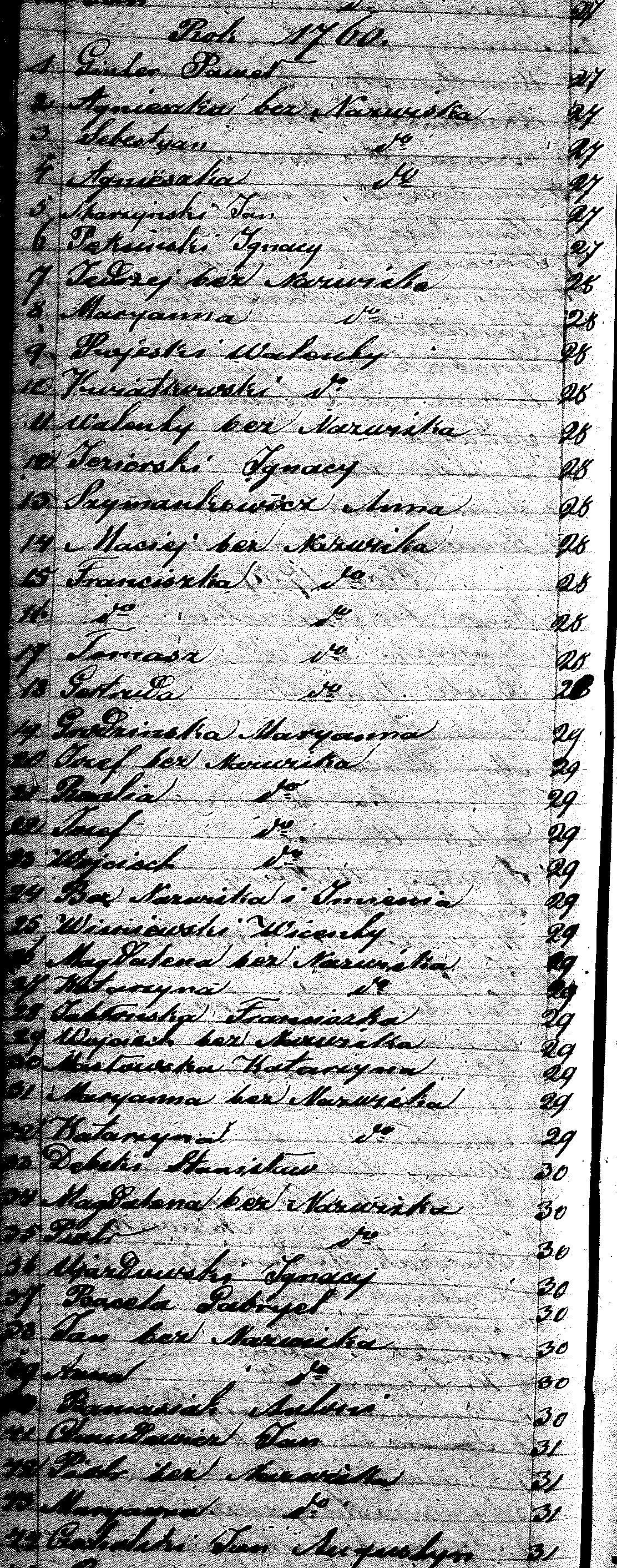
There are also multiple examples of individuals in the early 19th Century being recorded as "..." alias "..." The attached image of an index of individuals baptized in the parish of Przedecz in 1760 is a good example of how in some places in Poland roughly 50% of individuals still did not use a surname. The priest made it clear that the omission of the surname was not an oversight by noting the given name followed by the phrase "bez nazwiska/without a surname" in the index. The use of surnames was on the rise and by the last years of the 18th Century all the entries contained surnames, but the form of those surnames varied (e.g. a person one time could be recorded as Piasecki and another time as Piasek---surnames which have the same root meaning. In the case of Stopka vs. Miskowiec, as far as I know, the meaning of the two names is not similar.
I suppose the bottom line is that people in Poland in those days did not view surnames as unchangeable as we tend to do today.
Wishing you success in finding the reason for the two surnames,
Dave
| Description: |
|
| Filesize: |
1.7 MB |
| Viewed: |
7430 Time(s) |
|
|
|
|
Posted: Mon Jun 15, 2026 8:58 pm
Post subject: Miskowiec
I have the same situation. My 2xgreat grandmother was Zofia Miskowiec, but in some records it is listed as Wirmanska. I found this odd but then I found some later records for two individuals (early 1900s who I assume are related - same town) who use the hyphenated name Miskowiec-Wirmanski/a. Not sure what to make of it.
|
|
|
td85
Joined: 27 Oct 2020
Replies: 32
Location: Michigan, USABack to top |
Posted: Tue Jun 16, 2026 11:04 am
Post subject:
In my own research, I've found direct female ancestors in the 1800s who show up in some church records under their mother's maiden name. I'm not entirely sure why, but it might be something to keep in mind!
|
|
|
Posted: Tue Jun 16, 2026 3:19 pm
Post subject:
| td85 wrote: | | In my own research, I've found direct female ancestors in the 1800s who show up in some church records under their mother's maiden name. I'm not entirely sure why, but it might be something to keep in mind! |
Thanks! That makes some sense. I am trying to get ahold of Zofia's marriage record to find out who her parents were. Czarny Dunajec church has no written me back yet, but I know they should have the record. It is too far back to appear on geneteka.com (pre 1890), so I am hoping the church comes through. Otherwise I am going to have to travel there (or to Krakow - their archive should have it as well) or find a local researcher to retrieve it for me.
|
|
|
BarbOsloPO Top Contributor
Joined: 19 Nov 2022
Replies: 1645
Location: NorwayBack to top |
Posted: Tue Jun 16, 2026 6:08 pm
Post subject: Re: Miskowiec
| tomjwalsh wrote: | | I have the same situation. My 2xgreat grandmother was Zofia Miskowiec, but in some records it is listed as Wirmanska. I found this odd but then I found some later records for two individuals (early 1900s who I assume are related - same town) who use the hyphenated name Miskowiec-Wirmanski/a. Not sure what to make of it. |
Hi,
Among the Polish Highlanders (especially in the Podhale region), it is common to encounter a situation where a person is associated with two surnames. This stems from the tradition of clan nicknames (known as "przydomki rodowe"). In mountain villages, many families shared the same surname, such as Bachleda. To distinguish between the different branches of the clan, they were given nicknames that over time became highly important within the local community. For example, someone might formally be named "Jan Bachleda," but in the village, he was known as "Jan Bachleda Curuś" or simply "Jan Curuś."This nickname helped to more precisely identify a specific family within the community and to differentiate its various ancestral lines.
Regards,
-Barb
|
|
|
BarbOsloPO Top Contributor
Joined: 19 Nov 2022
Replies: 1645
Location: NorwayBack to top |
Posted: Tue Jun 16, 2026 6:58 pm
Post subject:
| tomjwalsh wrote: | | td85 wrote: | | In my own research, I've found direct female ancestors in the 1800s who show up in some church records under their mother's maiden name. I'm not entirely sure why, but it might be something to keep in mind! |
Thanks! That makes some sense. I am trying to get ahold of Zofia's marriage record to find out who her parents were. Czarny Dunajec church has no written me back yet, but I know they should have the record. It is too far back to appear on geneteka.com (pre 1890), so I am hoping the church comes through. Otherwise I am going to have to travel there (or to Krakow - their archive should have it as well) or find a local researcher to retrieve it for me. |
Hi,
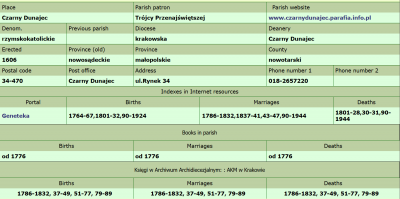
These years from Czarny Dunajec are available. Unfortunately, you cannot see everything in Genetyka.
-Barb
| Description: |
|
| Filesize: |
101.26 KB |
| Viewed: |
0 Time(s) |
|
|
|
|
Posted: Tue Jun 16, 2026 10:58 pm
Post subject: Re: Miskowiec
| BarbOslo wrote: | | tomjwalsh wrote: | | I have the same situation. My 2xgreat grandmother was Zofia Miskowiec, but in some records it is listed as Wirmanska. I found this odd but then I found some later records for two individuals (early 1900s who I assume are related - same town) who use the hyphenated name Miskowiec-Wirmanski/a. Not sure what to make of it. |
Hi,
Among the Polish Highlanders (especially in the Podhale region), it is common to encounter a situation where a person is associated with two surnames. This stems from the tradition of clan nicknames (known as "przydomki rodowe"). In mountain villages, many families shared the same surname, such as Bachleda. To distinguish between the different branches of the clan, they were given nicknames that over time became highly important within the local community. For example, someone might formally be named "Jan Bachleda," but in the village, he was known as "Jan Bachleda Curuś" or simply "Jan Curuś."This nickname helped to more precisely identify a specific family within the community and to differentiate its various ancestral lines.
Regards,
-Barb |
Thank you Barb! I appreciate the explanation.
|
|
|
|
|
|








 FAQ
FAQ Search
 Memberlist
 Profile
 Log in to check your private messages
 Log in
 Register