 Posted: Sun Dec 02, 2012 11:21 am
Post subject: Travel: How would one travel from Poland to Bremen in 1913
Posted: Sun Dec 02, 2012 11:21 am
Post subject: Travel: How would one travel from Poland to Bremen in 1913
My Great Grandmother was born in the Sierpc area. She came to America via Bremen, Germany in May of 1913. I googled the distance and it is approx 857 Km. How would one travel that distance in 1913 across mutliple countries?
Would you travel by train, automobile, or boat? Would you have to have a Visa (or like document) to travel from Russia into Germany? Would your family accompany you to Bemen? What kind of documents would you need to board the ship to America.
I'm very curious about the journey and I am ignorant as to what documents you would need. Watching movies about the wars in Europe, you aways hear about folks needing "papers" to travel and that they were always carried on your person.
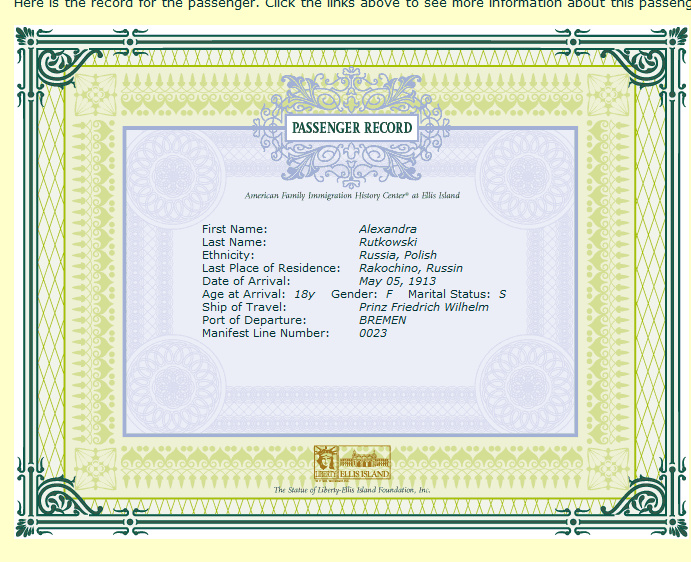
The ship manifest indicates my GGM had $10 dollars and was a Maid Servant, if that gives any meaning to what her family life would have been like in Poland.
I have attached her Ellis Island Passenger record.
Which I would not have but for the help of the great folks on Polish Origins, Thanks
| Description: |
|
| Filesize: |
261.42 KB |
| Viewed: |
6621 Time(s) |
|
|
|
|
Posted: Sun Dec 02, 2012 4:34 pm
Post subject: Re: Travel: How would one travel from Poland to Bremen in 19
| lorrir wrote: | My Great Grandmother was born in the Sierpc area. She came to America via Bremen, Germany in May of 1913. I googled the distance and it is approx 857 Km. How would one travel that distance in 1913 across mutliple countries?
Would you travel by train, automobile, or boat? Would you have to have a Visa (or like document) to travel from Russia into Germany? Would your family accompany you to Bemen? What kind of documents would you need to board the ship to America.
I'm very curious about the journey and I am ignorant as to what documents you would need. Watching movies about the wars in Europe, you aways hear about folks needing "papers" to travel and that they were always carried on your person.
The ship manifest indicates my GGM had $10 dollars and was a Maid Servant, if that gives any meaning to what her family life would have been like in Poland.
I have attached her Ellis Island Passenger record.
Which I would not have but for the help of the great folks on Polish Origins, Thanks |
Lorrir,
Not sure if in 1913 it was much different from 1890 or so. Usually, by wagons (or even by horse or on foot) till the next train station and from there to Bremerhaven or Hamburg. This link, in polish, displays the polish railroad system through the years. You need to install it. TYou can zoom it in and out as you wish.
http://woznyj.republika.pl/mapa.html
Papers to travel: excert from Hoffman's article "Mutilation; the fate of Eastern European Names in America" (http://www.pgsa.org/PDFs/Mutilation.pdf)
"You see, comparatively few immigrants just “showed up” at ports of entry. The majority came by
ship — it was easier than swimming from Europe. All right, did those ships just pull up at the dock,
dump their passengers, and sail off? No, they supplied the immigration officials with lists of paid passengers.
The officials had those lists to refer to as they processed the new arrivals. And it’s a pretty good
bet — bureaucrats being the way they are — those officials went by those lists: you were in trouble if
your name wasn’t on them; if your name was on them, that was your name, no if’s, and’s, or but’s.
Where did the lists come from? Probably from the shipping line’s list of paid passengers. Those
passengers had purchased tickets, boarded the ship in Europe, and proved their identity with papers — if
not to the shipping line’s agents, then surely to the police of the port town, with whom they were expected
to register as transients. Where did those papers come from? Ultimately, from the immigrant’s old home.
The partitioning governments kept close track of their subjects — so they couldn’t weasel out of military
service or paying taxes — and traveling without the proper papers was not exactly encouraged. (Of
course, some people emigrated illegally or with forged papers anyway.)
Gilberto
|
|
|
Posted: Sun Dec 02, 2012 6:02 pm
Post subject:
A good book to read for an idea of what that journey might have been like is "Jadwigas Crossing". I have shared it with many people and the find it very interesting. I hope you and others will enjoy it.
|
|
|
Elzbieta PorteneuvePO Top Contributor
Joined: 09 Nov 2012
Replies: 3098
Location: Paris, FranceBack to top |
Posted: Sun Dec 02, 2012 6:17 pm
Post subject:
Gilberto, Lorrir,
You may find an excelent site about European Railways between 1870 and 2000
http://www.europa.udl.cat/contents/transport-infrastructures/railways/europe/maps
Railways were changing quickly, they provide 3 maps: 1870-1900, 1900-1930 and 1930-2000.
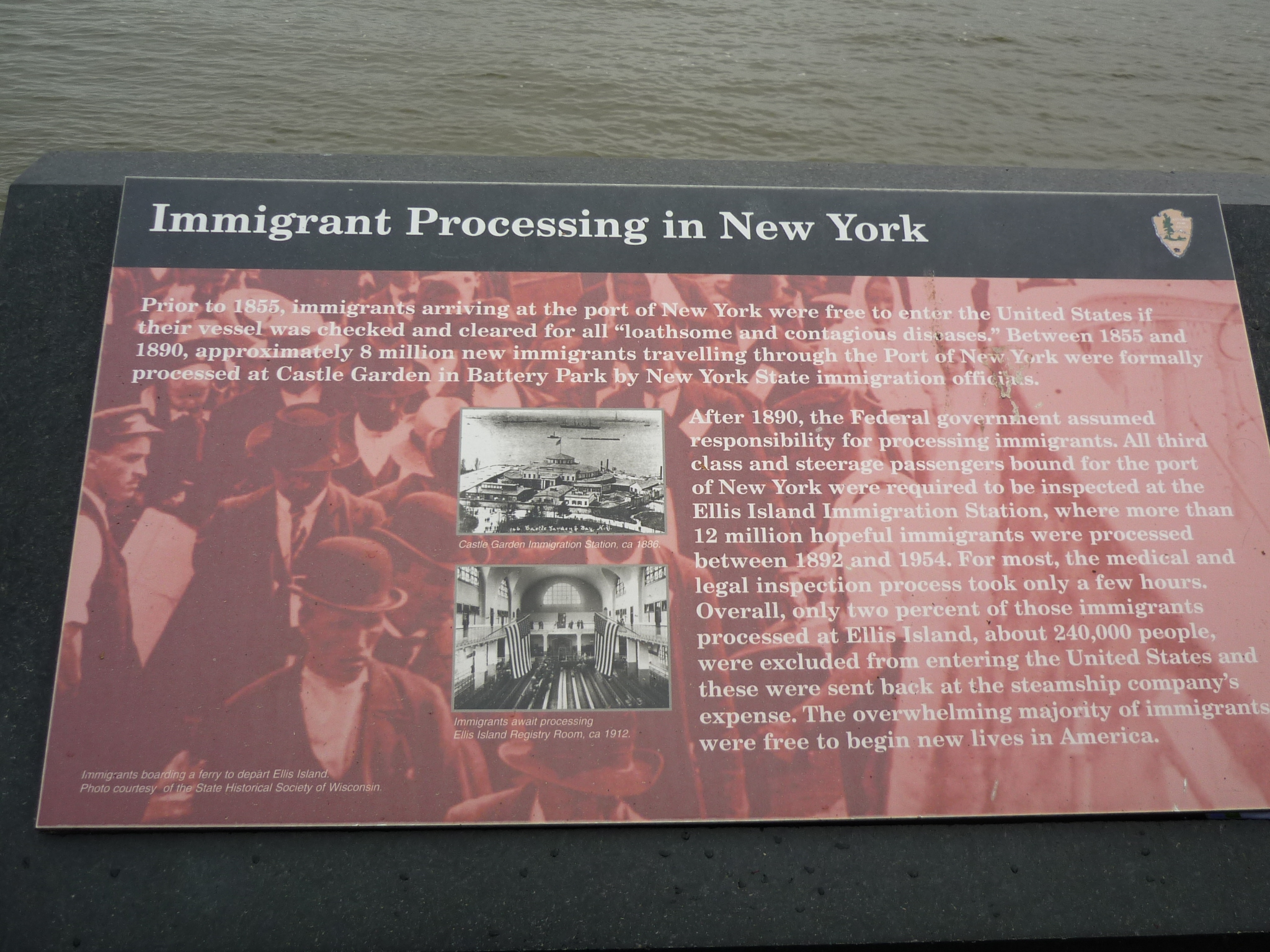
I have been visiting Ellis Island when in NY in 2011, very emotional place. Here is a pic I took giving few numbers, and procedures. I recall that our guide said it took on average 1 minute per immigrant to be seen by a medical doctor, and that for the majority of immigrants it was the first time ever they have seen a doctor.
Elzbieta
| Description: |
|
| Filesize: |
1.47 MB |
| Viewed: |
6621 Time(s) |
|
|
|
|
Elzbieta PorteneuvePO Top Contributor
Joined: 09 Nov 2012
Replies: 3098
Location: Paris, FranceBack to top |
Posted: Sun Dec 02, 2012 6:27 pm
Post subject:
I recall the Ellis Island guide saying that the travel cost was $25 and that it was one year income. For that $25 the ship owner was providing a soup to feed passengers. The sanitary conditions were bad. It could take 1 to 6 weeks to accross Atlantic, depending on the ship and weather. The people arriving to NY were exhausted by travel, but still lucky, because they made it.
|
|
|
ZenonPolishOrigins Team Leader

Joined: 28 Apr 2007
Replies: 1532
Location: PolandBack to top |
|
|
|
|








 FAQ
FAQ Search
 Memberlist
 Profile
 Log in to check your private messages
 Log in
 Register