kyushukev
Joined: 10 Aug 2025
Replies: 28
Location: TennesseeBack to top |
 Posted: Sun Aug 31, 2025 9:26 am
Post subject: Witness or świadek
Were there any requirements or written or unwritten rules to be a świadek? For any records-birth, marriage and death.
Did both sides of the family have to be represented? Who would do the choosing?
I'm asking for a reason, but I wanted to start out broad and then narrow my questioning.
Thanks,
Kevin
|
|
|
dnowickiPO Top Contributor
Joined: 28 Dec 2011
Replies: 2963
Location: Michigan City, IndianaBack to top |
Posted: Sun Sep 07, 2025 4:15 pm
Post subject: Re: Witness or świadek
| kyushukev wrote: | Were there any requirements or written or unwritten rules to be a świadek? For any records-birth, marriage and death.
Did both sides of the family have to be represented? Who would do the choosing?
I'm asking for a reason, but I wanted to start out broad and then narrow my questioning.
Thanks,
Kevin |
Hi Kevin,
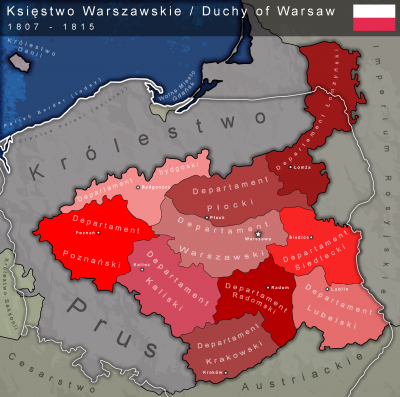
It seems that your questions are directed towards civil records from the Russian ruled Kingdom of Poland (Królestwo Polskie). Prior to the Partitions the Polish-Lithuanian Commonwealth formally known as The Kingdom of Poland and the Grand Duchy of Lithuania (Królestwo Polskie i Wielkie Księstwo Litewskie) had no system of civil registration. Ecclesiastical records acted as civil record substitutes. The only ecclesiastical records in which witnesses (testes/świadkowie) are found are marriage records. The Roman Catholic Church required marriages to take place in the presence of a priest and two other witnesses, whose job it was and is to listen to the words of consent exchanged by the bride and the groom and to note that the consent had taken place freely and verbally. Witnesses/świadkowie in civil records first appear during the Napoleonic Wars in the Duchy of Warsaw (Księstwo Warszawskie), a French satellite state created by Napoleon. The Duchy was dissolved by the Congress of Vienna in 1815. However, the style of civil records known as long paragraph records continued to exist in the regions of the old Polish-Lithuanian Commonwealth given to Russia by the Congress of Vienna. This style of record endured until the end of WW I and then continued in the Second Polish Republic following the war. The naming of witnesses continued to be required for birth, marriage and death records but the witnesses are never actually asked to formally witness any action or part of the record. Much of what is found in the civil records is simply bureaucratic fiction. For example—In marriage records the text often reads that the witnesses informed the civil registrar aka the pastor of the parish that a religious marriage had taken place between the named groom and bride. An example of pure fiction. The priest certainly did not need to be informed since the wedding took place in his presence and part of his job was to give the nuptial blessing in the name of the Church. In the case of marriage records the witnesses did have an actual function which was to listen to the words of consent exchanged by the bride and the groom and to note that the consent had taken place freely and verbally. For birth and death records the witnesses had no role to play in the events recorded. Usually they were not present for the birth or the death.
To answer your questions...For any records-birth, marriage and death...
Did both sides of the family have to be represented? No. Frequently the witnesses were not relatives of the individual or individuals named in the record. Often they were neighbors from the village or friends who were not related either by consanguinity or by affinity.
Who would do the choosing? For birth records— the father and/or the mother of the child. For marriage records—usually the groom and the bride. For death records—usually the informant (who sometimes was a relative of the deceased but sometimes was a neighbor who had been asked by the family of the deceased. In reality the informant was doing what a funeral director does, i.e. gathering the information to be used in a civil death certificate. About the only unwritten qualification to act as a witness, as far as I can tell, was to be of sufficient age and capacity to accurately know and remember what had taken place.
I hope that this provides the answers you were seeking.
All the best,
Dave
|
|
|
kyushukev
Joined: 10 Aug 2025
Replies: 28
Location: TennesseeBack to top |
Posted: Sun Sep 07, 2025 7:14 pm
Post subject: Witness or świadek
Wow. Thanks Dave, that's a big help.
The record in question is in Kakawa in 1867, when Anna Borowska gave birth to daughter Maryanna. There was no father mentioned, and to make a long story short, I believe the father to be one of 2 Chwiałkowski half-brothers, Tomasz (1830) and Michał (with a different mother in 1846). When I went through the witnesses and godparents, one name kept popping up.
8 July 1867 Anna’s daughter Marianna is born. (Anna's parents are Wojciech Borowski and Petronella Kordulińska.)
Date of record: Godziesze Wielkie, 10 July 1867, 10 a.m.
Informant: Barbara Kaczmarkowa , age 60, midwife from Kakawa
Witnesses: Stanisław Bartczak, age 26, and Tomasz Król, age 29, both farmers from Kakawa
Child: female child named Marianna born in Kakawa on the 8th of this month and year at 6 a.m. to Anna Borowska, age 20, village servant from Kakawa ["słuzący wiejskiej z Kakawy"; no father listed]
Godparents: Stanisław Jasiński and Marcianna Jasińska.
Stanisław Jasiński was himself the son of a single mother. Wojciech was a witness at his wedding in 1859 and the birth of his daughter Józefa in 1862, and again in 1864.
Marcianna Jasińska is a bit of a cypher. I'm not sure how she relates to Stanisław, or how old she is, or even if she married and had children. I see 6 definite appearances at BaSIA, between 1858-'67, always as a chrzestna. In 1866, she appears with chrzestny Tomasz Chwiłkowski at the birth of his brother Jan's daughter, while in 1867, she's chrzestna for Tomasz Król's son.
Stanisław Bartczak's mother is Zofia Cichońska, which I don't think is a Chwiałkowski variation. Wojciech Borowski is a witness for his son Jan's baptism in 1865. Stanislaw is a witness and Jan Chwiłkowski chrzestny for Katarzyna Chwiłkowska's daughter in 1865 (Tomasz' siblings). Tomasz Chwiłkowski is a chrzestny at Stanislaw's son Józef's 1867 baptism (Jan looks to be a witness). Stanislaw is chrzestny and Tomasz and Jan Chwiałkowskis witnesses for Petronella's brother Idzi's son in 1868.
Witness Tomasz Król appeared with Jan Chwiłkowska's wife Józefa at baptisms in 1863 (Katarzyna Chwiałkowska's daughter) and '67, and Król was a witness when Tomasz Chwiłkowska was chrzestny to single mother Anna Król's son in 1864 (Indexed as Antonina, but the register says Anna and she's 20. I believe this is Tomasz' sister Anna born 1838, so she'd be 26). When Król's parents died in 1860, Tomasz Chwiłkowska was a witness each time. I'm not sure of any family connections. I don't see any Borowski involvement with the Króls.
So if Anna picked the people, I think she was sending a message.
Tomasz and Jan Chwiłkowska, along with Wojciech Borowski, appear in numerous church records as witnesses and godparents, including together, and for each other's children, so the families knew and interacted with each other. I wouldn't be surprised if discretion was the better part of valor, as Anna's next mention is in Kalisz in 1870 for her marriage to Adam Glownia.
|
|
|
marcelproustPO Top Contributor
Joined: 28 Jun 2014
Replies: 4800
Location: PolandBack to top |
Posted: Mon Sep 08, 2025 4:37 am
Post subject:
Here is some info I would like to add:
| Description: |
|
| Filesize: |
305.46 KB |
| Viewed: |
0 Time(s) |

|
_________________
My translations are voluntary, but they take a lot of time and effort, so whenever you want to send money it will be a very nice "Thank you" gift to me.
THANK YOU 
PAYPAL: [email protected]
|
|
|
dnowickiPO Top Contributor
Joined: 28 Dec 2011
Replies: 2963
Location: Michigan City, IndianaBack to top |
Posted: Mon Sep 08, 2025 7:34 am
Post subject:
| marcelproust wrote: | | Here is some info I would like to add: |
Hi Marcel,
The information you posted about witnesses in the Napoleonic Code is valuable background information. It is necessary to keep in mind that the Napoleonic Code was really the product of the anti-clericalism of the French Revolution and reflected Napoleon’s conflicted relationship with the Roman Catholic Church. The Napoleonic Code was in force only in the Duchy of Warsaw which existed only from 1807 until after the downfall of Napoleon and was ended definitively by the Congress of Vienna in 1815. The majority of the territory of the Duchy was transferred to Russia by the Congress of Vienna and became the Kingdom of Poland (Królestwo Polskie) aka the Congress Kingdom a part of the Russian Empire in personal union with the Czar of Russia as king of Poland. Although the record format known as the Napoleonic long paragraph form continued to be used in the Russian ruled Kingdom of Poland it was only the format and not the requirements of the Napoleonic Code which remained in use. The legal requirements of the Napoleonic Code were a thing of the past in Polish lands after 1815.
Dave
| Description: |
|
| Filesize: |
1.17 MB |
| Viewed: |
0 Time(s) |
|
|
|
|
dnowickiPO Top Contributor
Joined: 28 Dec 2011
Replies: 2963
Location: Michigan City, IndianaBack to top |
Posted: Mon Sep 08, 2025 7:36 am
Post subject: Re: Witness or świadek
| kyushukev wrote: | Wow. Thanks Dave, that's a big help.
The record in question is in Kakawa in 1867, when Anna Borowska gave birth to daughter Maryanna. There was no father mentioned, and to make a long story short, I believe the father to be one of 2 Chwiałkowski half-brothers, Tomasz (1830) and Michał (with a different mother in 1846). When I went through the witnesses and godparents, one name kept popping up.
8 July 1867 Anna’s daughter Marianna is born. (Anna's parents are Wojciech Borowski and Petronella Kordulińska.)
Date of record: Godziesze Wielkie, 10 July 1867, 10 a.m.
Informant: Barbara Kaczmarkowa , age 60, midwife from Kakawa
Witnesses: Stanisław Bartczak, age 26, and Tomasz Król, age 29, both farmers from Kakawa
Child: female child named Marianna born in Kakawa on the 8th of this month and year at 6 a.m. to Anna Borowska, age 20, village servant from Kakawa ["słuzący wiejskiej z Kakawy"; no father listed]
Godparents: Stanisław Jasiński and Marcianna Jasińska.
Stanisław Jasiński was himself the son of a single mother. Wojciech was a witness at his wedding in 1859 and the birth of his daughter Józefa in 1862, and again in 1864.
Marcianna Jasińska is a bit of a cypher. I'm not sure how she relates to Stanisław, or how old she is, or even if she married and had children. I see 6 definite appearances at BaSIA, between 1858-'67, always as a chrzestna. In 1866, she appears with chrzestny Tomasz Chwiłkowski at the birth of his brother Jan's daughter, while in 1867, she's chrzestna for Tomasz Król's son.
Stanisław Bartczak's mother is Zofia Cichońska, which I don't think is a Chwiałkowski variation. Wojciech Borowski is a witness for his son Jan's baptism in 1865. Stanislaw is a witness and Jan Chwiłkowski chrzestny for Katarzyna Chwiłkowska's daughter in 1865 (Tomasz' siblings). Tomasz Chwiłkowski is a chrzestny at Stanislaw's son Józef's 1867 baptism (Jan looks to be a witness). Stanislaw is chrzestny and Tomasz and Jan Chwiałkowskis witnesses for Petronella's brother Idzi's son in 1868.
Witness Tomasz Król appeared with Jan Chwiłkowska's wife Józefa at baptisms in 1863 (Katarzyna Chwiałkowska's daughter) and '67, and Król was a witness when Tomasz Chwiłkowska was chrzestny to single mother Anna Król's son in 1864 (Indexed as Antonina, but the register says Anna and she's 20. I believe this is Tomasz' sister Anna born 1838, so she'd be 26). When Król's parents died in 1860, Tomasz Chwiłkowska was a witness each time. I'm not sure of any family connections. I don't see any Borowski involvement with the Króls.
So if Anna picked the people, I think she was sending a message.
Tomasz and Jan Chwiłkowska, along with Wojciech Borowski, appear in numerous church records as witnesses and godparents, including together, and for each other's children, so the families knew and interacted with each other. I wouldn't be surprised if discretion was the better part of valor, as Anna's next mention is in Kalisz in 1870 for her marriage to Adam Glownia. |
Hi Kevin,
Being named as a chrzestna puts her role on an entirely different level from witnesses. When time and inclination allow I’ll share some comments about the roles of individuals in the sacrament of baptism. This probably won’t happen for a few days.
Dave
|
|
|
kyushukev
Joined: 10 Aug 2025
Replies: 28
Location: TennesseeBack to top |
Posted: Mon Sep 08, 2025 2:03 pm
Post subject: Witness or świadek
Thanks again for your help, Dave. I look forward to your new information. I was kind of surprised I couldn't find anything when I searched.
I've added Maryanna's baptismal record in case that might be of interest.
I've run across illegitimate births in my research before, but I don't think they were all sent to Kalisz, so something seems to have happened. Maryanna, her husband, and 2 children emigrated to New Hampshire in 1890, and she completely changed her backstory, saying they were from Warsaw among other things, and it took me some 20 years to finally break through.
Take care,
Kevin
| Description: |
|
| Filesize: |
972.58 KB |
| Viewed: |
0 Time(s) |

|
|
|
|
dnowickiPO Top Contributor
Joined: 28 Dec 2011
Replies: 2963
Location: Michigan City, IndianaBack to top |
Posted: Mon Sep 15, 2025 10:37 am
Post subject: Re: Witness or świadek
| kyushukev wrote: | Thanks again for your help, Dave. I look forward to your new information. I was kind of surprised I couldn't find anything when I searched.
I've added Maryanna's baptismal record in case that might be of interest.
I've run across illegitimate births in my research before, but I don't think they were all sent to Kalisz, so something seems to have happened. Maryanna, her husband, and 2 children emigrated to New Hampshire in 1890, and she completely changed her backstory, saying they were from Warsaw among other things, and it took me some 20 years to finally break through.
Take care,
Kevin |
Hi Kevin,
Here follows an analysis of the 1867 birth record of Maryanna:
The informant was the midwife since the child was illegitimate and no man acknowledged paternity. The midwife was probably chosen by the mother prior to the birth. In most places several women worked as midwives and so the soon-to-be mother made the choice of which midwife she wanted to assist at the birth of her child. The record name is the midwife as Barbara Kaczmarkowa. The suffix -owa was used by married women and the suffix indicates that she was the wife of a man named Kaczmarek. In contemporary Polish usage her surname would simply have been Kaczmarek. The midwife chose the two witnesses who would accompany her and they were two male villagers who were available and willing to accompany her. Their function basically was to assure that the information being provided was accurate. If they were actors in a movie they would not have a speaking role and probably would be viewed as extras. The sponsors/godparents would have been chosen by the mother. They had a liturgical role to play in the baptismal ceremony. The record does not provide any information about them other than their names.
The Rite of Baptism used during the 19th century was designed for adult converts rather than infants. The ritual was conducted in Latin with a few exceptions of direct questions directed to the sponsors/godparents. One or both of the godparents held the child as the priest poured the water accompanied by the words “Ego te baptizo in Nomine Patris, et Filii, et Spiritus Sancti.” (I baptize you in the Name of the Father and of the Son and of the Holy Spirit). After the baptismal ceremony the sponsors godparents carried the child home to her mother.
Of course, in the early days of Christianity those who were baptized were adult converts. Infant baptism did not become common until the 5th Century.
Witnesses as opposed to god parents were very minor players since they had no actual role in the baptism itself. The main reason that they accompanied the informant when the record was composed was that they were from the village where the event to be recorded took place and were willing and available to accompany the informant to the parish office. To try to extrapolate relations between the witnesses and the main parties in the record is usually an exercise in futility since very often all that they had in common was that they lived in the same village. A good source of information about the parish and the villages which belong to that parish is the Słownik geograficzny. Here is a link to the entry for Kakawa— http://dir.icm.edu.pl/pl/Slownik_geograficzny/Tom_III/673 Your Kakawa is #2 in the entry. Kakawa was a village and a manorial farmstead. The village had 29 houses with a population of 390. Given the size of the village the inhabitants certainly knew each other with varying degrees of familiarity. The inhabitants of the village we’re neighbors but did not necessarily have any more significant relationship than that of neighbors.
Given the fluidity in the spelling and suffixes of surnames during the 19th century this is probably the record of the marriage of Wojciech and Petronella from Poznan Project (also found indexed on BaSIA
Catholic parish Godziesze
entry 18 / 1843
• Wojciech Borowczyk (25 years old) 75%
father: Paweł + , mother: Katarzyna Łaska
• Petronela Kordelasówna* (18 years old)
father: Franciszek , mother: Franciszka +
Another site where records for the parish of Godziesze are housed is Family Search https://www.familysearch.org/en/search/catalog/results?q.place=Godziesze%20Wielkie%2C%20Kalisz%2C%20Greater%20Poland%2C%20Poland&subjectsOpen=133492089-2
These are the ecclesiastical records housed in the archives of the Diocese of Włocławek. They are found in the archives of the Diocese of Włocławek because during the 19th Century until after WWI the diocese had two cathedral cities, Włocławek and Kalisz. Kalisz was under Prussian rule as part of South Prussia until the region was transferred to Russian control. The Roman Catholic Church did not want the territory of a diocese to span two political jurisdictions and thus Kalisz, which came to be under Russian rule was annexed to the Diocese of Włocławek. The records in the Diocesan archive are records which are not available anywhere else. The downside is that they cannot be searched via armchair genealogy from the comfort of home. Due to contractual obligations between the diocese and Family Search aka the Genealogical Society of Utah In order to access the records by computer one must travel to a family history center or an affiliated library. However, I’m sure the trip would be worth it in order to access records for the parish of Godziesze dating back to the early 18th Century.
I hope that you find the above comments helpful.
Wishing you continued success in your research,
Dave
|
|
|
BarbOsloPO Top Contributor
Joined: 19 Nov 2022
Replies: 1670
Location: NorwayBack to top |
Posted: Mon Sep 15, 2025 10:55 am
Post subject:
|
|
|
kyushukev
Joined: 10 Aug 2025
Replies: 28
Location: TennesseeBack to top |
Posted: Mon Sep 15, 2025 12:35 pm
Post subject: Witness or świadek
Hi Dave and Barb,
Thanks for the comprehensive replies. This really answers a lot of questions. In going through the Borowskis and Chwiłkowski records, I've seen how families all tie in together. In fact, those 2 families are cousins.
I have seen the Słownik geograficzny, in fact I was going through it yesterday. I found a copy of Vol. 3 at the InternetArchives. I can get a screenshot, convert it to text, then google translate. Complicated, but it works pretty well.
Kakawa also has an 1846 tax list at the archives, which gives land holdings and taxes, paid partially in capons, ducks, geese, and eggs.
I also took a look at Barbara Kaczmarkowa yesterday at BaSIA, and found something surprising.
Of the 30-odd births Barbara assisted between 1859 and ‘65, all but 2 were single mothers. One couple she assisted was Tomasz Bijacik and Katarzyna Chwiłkowska in 1859, whose brothers Jan and Tomasz were also involved. She also midwifed for Tomasz Król's sister Anna in 1864 as noted above. Wojciech Borowski was chrzestny for single mother Barbara Maćczak in 1864 with Barbara as midwife.
With 390 people in 1880, that's a pretty good sized number of out-of-wedlock births. And that's just with one midwife.
So it wasn't the bombshell information I was hoping for, but I think I still have enough to implicate Tomasz, including a DNA match with Michalak at MyHeritage (through his mother's father).
Unfortunately, the FHC in town is only open for an hour a week on Weds. evenings, so thank goodness for Szukaj w Archiwach online. Having 3 different searchable online databases is also amazing, especially after combing through records via familysearch.org. Maryanna Borowska Winkler was very touchy about her birth and probably the way her mother was treated, so did her best to obfuscate and obscure her past, like saying they were from Warsaw.
I deeply appreciate everyone's help here. If anyone here has an Ancestry sub, my tree is The Theory of Riley-tivity.
Take care,
Kevin
|
|
|
|
|
|




 FAQ
 Search
 Memberlist
 Profile
 Log in to check your private messages
 Log in
 Register