ShelliePO Top Contributor & Patron

Joined: 18 Feb 2009
Replies: 1000
Location: Atlanta, GABack to top |
 Posted: Sat Apr 16, 2011 5:09 pm
Post subject: Chmielnik village in Podkarpakie, near Rzeszow
Posted: Sat Apr 16, 2011 5:09 pm
Post subject: Chmielnik village in Podkarpakie, near Rzeszow
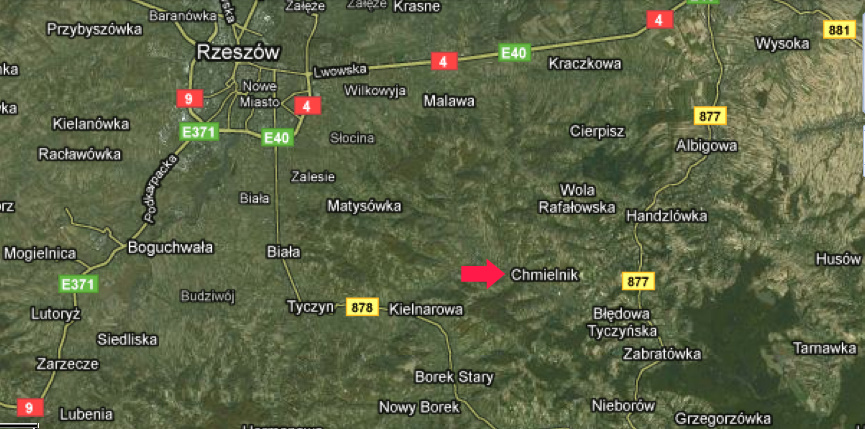
Chmielnik is a village located southeast of Rzeszow It should not be confused with the village of the same name near Kielce.
This village has a webpage, in Polish. I have pasted a link to the Google translated version. Please note that when Google translates a webpage, it also translates village names and surnames. For example, one surname on this page is Button Hook in English! If a word looks strange, you can put your cursor over it and see the original Polish word: http://tinyurl.com/Chmielnik-web-page
Here is some history from the Chmielnik webpage - note that is is translated by Google translator and may not be the best translation:
Chmielnik. The origins are not known. On the basis of the extant records can be assumed that the village has an old metric. The first reference dating from 1419, says Nicolau Laurini - rectory of Chmielnik, who was a co-founder of the priestly fraternity for the estate of Rzeszow and Tyczyński. We can draw the conclusion that even then was a village Chmielnik large, since there was a church. Hamlet is governed by German law. Since the times of historically known to us belonged to a village called tyczyńskiego state. As a private village, belonged to Chmielnik Pilecki, Kostka, and Branickis tyczńskich. After the collapse of the goods in the mid-nineteenth century, the local property was owned by Szymanowski, and later Wallisów, Branicki and Kłapowskich.
Brannicy were good hosts and took care of his estate even when you're away from them. Their achievement is, among others, thoroughly organize the administration of these goods. In times Branickich Chmielnik lived to see the new church - in place of the old wood, which was destroyed during the Tartar invasion in 1624 it was erected in 1742 on the initiative of the pastor Khmelnitsky, Stanislaw Wacławskiego. In 1753 the bishop of Przemysl, Albert Sierakowski, consecrated the church, which exists to this day, being a place of special devotion to Our Lady of Grace. Over the years, made some changes and renovations in the church - including new aisles were added (1951-1958). In the first half. XVIII of the Church was built next to the brick bell tower (in a square two-storey, with the corners covered pilasters). To the parish in Chmielnik since its inception, was also owned Błędowa Tyczyńska. It was separated only in 1958.
Hamlet has been developing very dynamically. Did not avoid it, however, epidemics, disasters, war, which influenced the tragic fate of the inhabitants because the wooden building, was particularly severe in its consequences were fires. The Tartars made their way here, destroying what stood in their way. The most acute for Chmielniczan invasion of 1624 was the year when it burned down a church.
In the first half. Nineteenth century in addition to the parish church Chmielnik with a brick bell tower was a large farm parsonic (11 wooden buildings), wooden inn, a wooden water mill, manor and grange manor (1 and 9 of the brick building wooden and stone chapel.) In 1880 he was also a municipal credit union. In 1889, he was already in Chmielnik two brick shrines at crossroads and cross the road to a roadside Malawy. After the war, the village has expanded considerably, both economically and culturally developed. In 1973 she became the seat of the newly created municipality.
| Description: |
| Click for a larger view of map. |
|
| Filesize: |
199.09 KB |
| Viewed: |
4995 Time(s) |
|
Last edited by Shellie on Sat Apr 16, 2011 6:07 pm; edited 2 times in total
|
|
|
Posted: Sat Apr 16, 2011 5:23 pm
Post subject:
Thank you Shelly for steering me to your forum topic on Chmielnik! I'm racing the clock here as I only have 10 more minutes for now....ah...your entry is so interesting....can't wait to come back to the forum!
PaniKohani
_________________
We are a continuum. Just as we reach back to our ancestors for our fundamental values, so we, as guardians of that legacy, must reach ahead to our children and their children. And we do so with a sense of sacredness in that reaching.
Paul Tsongas
|
|
|







 FAQ
FAQ Search
 Memberlist
 Profile
 Log in to check your private messages
 Log in
 Register