kcarnleyPolishOrigins Patron
Joined: 16 May 2012
Replies: 22
Back to top |
 Posted: Thu Jun 13, 2013 4:30 pm
Post subject: Help with Latin word...
Posted: Thu Jun 13, 2013 4:30 pm
Post subject: Help with Latin word...
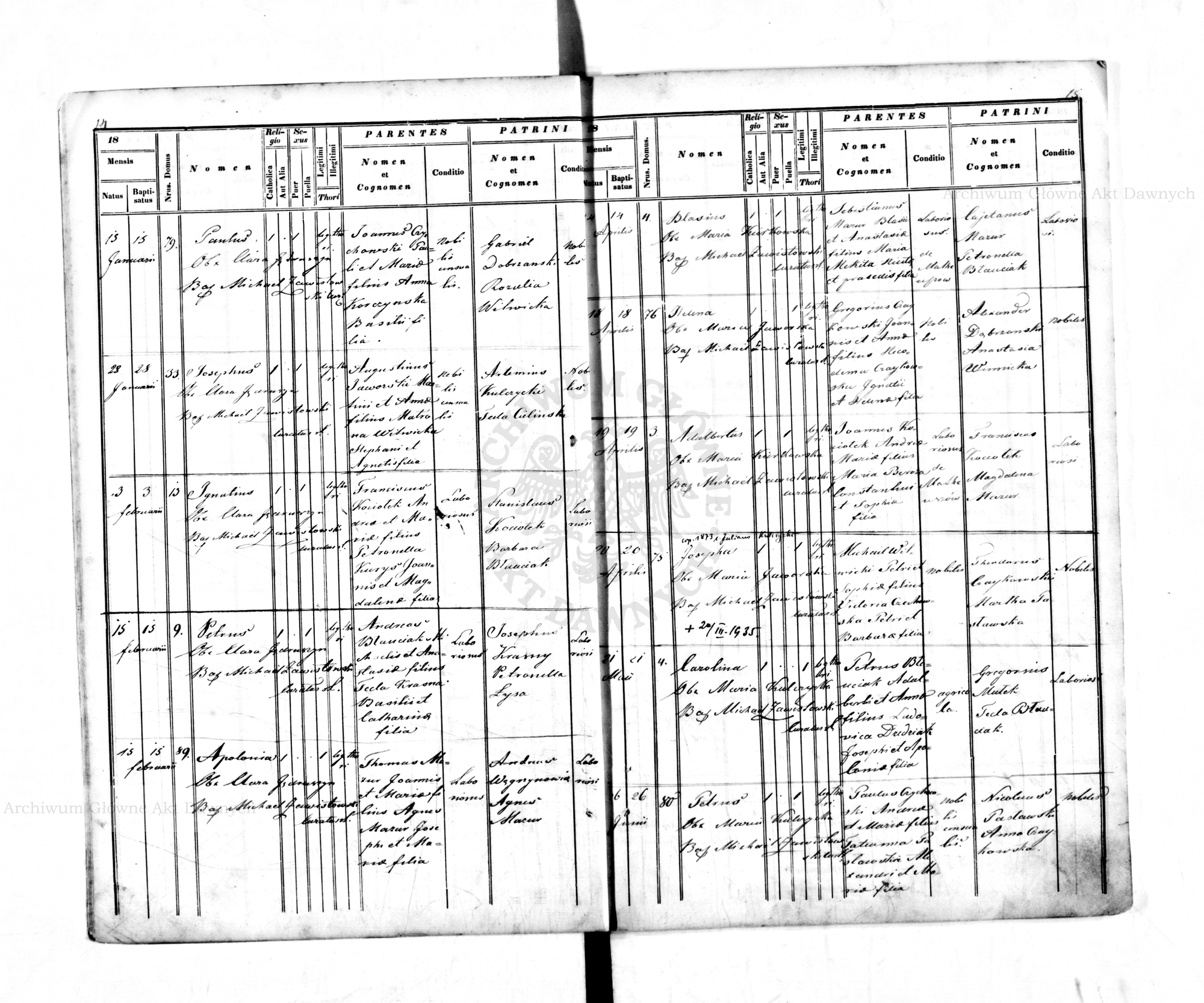
I am examining the Roman Catholic birth records for the village of Dobropole (modern-day Ukraine). In the column for CONDITIO (occupation) I have seen what I believe to be the term "Nobilis Censualis". I am familiar with "Nobilis" identifying the person as a noble, and this is what I most often encounter. However, in a few entries for both the parents and godparents I see the additional word. In the most legible entry it actually appears to be "unsualis" but none of the online latin dictionaries recognize the word. A few of the entries look like the word is actually "censualis".
If I search the word "censualis" in Google Translate it returns the word "Domesday". If I enter "nobilis censualis" it returns "noble Domesday". When I enter the word "censualis" in a few Latin dictionaries it says "of/connected with census of citizens". When I Google the two words together, "nobilis censualis", it finds nothing.
Has anybody else encountered these words on the records and have any idea what occupation it could be naming? It does not appear during the whole birth record. This metric spans 1845 - 1899 and only occurs during the first few years. Later only "nobilis" appears and towards the end of the record, maybe the last ten years, everybody is identified as a farmer, even those that are from the noble families.
If anybody is insistant on viewing the actual document I can upload it later. I don't have the ability from where I'm typing this. Sorry.
|
|
|
dnowickiPO Top Contributor
Joined: 28 Dec 2011
Replies: 2950
Location: Michigan City, IndianaBack to top |
Posted: Thu Jun 13, 2013 9:55 pm
Post subject:
The Classical Latin adjective censualis, e means "of or pertaining to the census of citizens. The word is related to the Latin census, i, m. census and censor, oris, m., censor. In early Roman times the censor was a magistrate charged with keeping the census rolls which distinguished citizens according to class and property. According to Seutonius, to be enrolled as a senator a citizen was required to be worth 800,000 sesterces and to be enrolled as a eques (knight) a citizen needed 400,000 sesterces in wealth. There is no Latin word "unsualis". However, there is an adjective "usualis, e.
Now to the tricky part...Latin as the vernacular of a particular nation/group died out in the centuries after the fall of the Roman Empire. However, that does not mean that it ceased to exist. As a vernacular it morphed into the Romance languages (Italian, Spanish, French, etc.) and survived as the language of scholarship and of the Catholic Church. During the many centuries after it ceased to be a national language it continued to develop and change with time and location. New words came into being and some Classical words were used with meanings which were not used in Golden and Silver Age Latin. No complete dictionary of Post-Classical Latin exists because usage varied from place to place and from time to time. Thus it is of no practical use to try to use Google to find the meaning of some Latin words used for example in 19th Century Poland. A good example of such a word would be "cmetho, onis, m, which is the equivalent of the Polish kmiec. There exists a lexicon of Latin as used in Poland---"Lexicon Mediae et Infimae Latinitatis Polonorum" by Marian Plezia. The time period covered by this work ends several centuries prior to the time period of the records you are researching, but it could very well shed some light on the usage you have found. Unfortunately, this lexicon is a multiple volume work which I do not own. I have used it at the library of the University of Wisconsin in Madison in the past. Since Madison is not a day trip from where I live, I have no plans to go there in the near future. The context in which a word appears often helps to shed light on the meaning of a particular word. Again, unfortunately, there is very little context in records in the columnar format. This all means that it is difficult to say whether censualis in this case maintained the meaning it had in Classical Latin or whether there was a different meaning for the word as used in a 19th Century Church record in Poland.
Regarding noble family members being identified as farmers...It was not uncommon for there to be no difference between nobles and peasants other than blood. There were nobles who had no more wealth than peasants so for all practical purposes they were farmers no different from peasant farmers.
If you would post the actual record/records I would be happy to see if there is anything in the record which clarifies the Latin usage.
Hope this helps to some degree.
Dave
|
|
|
kcarnleyPolishOrigins Patron
Joined: 16 May 2012
Replies: 22
Back to top |
Posted: Fri Jun 14, 2013 1:34 am
Post subject:
David, thanks for the thorough response. I am posting an image with the occupation listed three times so you will have several to study. Perhaps you or another forum member will be able to interpret the word differently.
I'm quite familiar with the poor Polish nobles as I'm descended from several of the village's noble families; most recently the Czajkowski and Witwicki. I just found it curious that the noble status was no longer being mentioned toward the last years of the book. Was this a personal decision made by the priest? Had the families lost their status? Was the village so poor and intermarried that it was no longer considered important?
While you're at it, look at the two Conditio entries on the second page where the person is identified as a laborer followed by what appears to be "de Malheupow" or "de Masheurzow". Would this identify the person as being from another villiage starting with "Ma........"? I've looked at several maps hoping to find the location this may be referring to without luck. Only one was remotely close, yet so remote in appearance of the spelling to say it's not correct.
| Description: |
| Example birth records from 1849 for village of Dobropole |
|
| Filesize: |
1.75 MB |
| Viewed: |
7307 Time(s) |
|
|
|
|
Elzbieta PorteneuvePO Top Contributor
Joined: 09 Nov 2012
Replies: 3098
Location: Paris, FranceBack to top |
Posted: Fri Jun 14, 2013 9:18 am
Post subject:
| kcarnley wrote: |
While you're at it, look at the two Conditio entries on the second page where the person is identified as a laborer followed by what appears to be "de Malheupow" or "de Masheurzow". Would this identify the person as being from another villiage starting with "Ma........"? |
Hi,
I read the both identifications as laboriosus de Matheuszow [no difficulty to decipher handwritten Matheuszow in both cases], which I could interpret (my French background) twofold:
1) worker from the (village of) Mateuszow [removing unnecessary h in Polish]
or
2) worker at (the house or property of) Mateuszow
Mateuszow is a declension of Mateusze, plural for Mateusz
English equivalent is Matthew
In Polish it is correct to say "jestesmy zaproszeni do Marcinow" - we are invited to [plural of the first name Marcin, declension], without using the last name, which is equivalent to say "jestesmy zaproszeni do Kowalskich" - we are invited to spouses Kowalski.
Not sure it helps.
Best,
Elzbieta
|
|
|
Posted: Fri Jun 14, 2013 10:46 am
Post subject:
| kcarnley wrote: |
While you're at it, look at the two Conditio entries on the second page where the person is identified as a laborer followed by what appears to be "de Malheupow" or "de Masheurzow". Would this identify the person as being from another villiage starting with "Ma........"? I've looked at several maps hoping to find the location this may be referring to without luck. Only one was remotely close, yet so remote in appearance of the spelling to say it's not correct. |
Hi,
the name of the place is Mateuszówka. You can see it here, close do Dobropole (on the right):
http://www.mapywig.org/m/wig25k/P52-S41-A_WISNIOWCZYK_1939.jpg
Gilberto
|
|
|
kcarnleyPolishOrigins Patron
Joined: 16 May 2012
Replies: 22
Back to top |
Posted: Fri Jun 14, 2013 4:23 pm
Post subject:
Another map to download. I looked at several earlier maps and that tiny hamlet wasn't shown. Nice catch. I suspected both entries were referencing the same place but the two spellings seemed slightly different which was throwing me off.
|
|
|
dnowickiPO Top Contributor
Joined: 28 Dec 2011
Replies: 2950
Location: Michigan City, IndianaBack to top |
Posted: Fri Jun 14, 2013 8:15 pm
Post subject:
You read the word correctly as censualis. There is nothing in the various entries which gives any indication of why the priest added it to certain entries and just used nobilis in others. I presume that all the Czajkowskis on the two pages are related to each other, either closely or distantly, and so too with all the Witwicki's. Looking at the entries raises more questions than answers. All the entries were made by the same priest. Is he distinguishing between the individuals or merely adding censualis on a whim? You would be in the best position to look for what if anything the three who are listed as nobiles censuales have in common which is not shared by the two who are simply listed as nobiles. Also, there is a marriage notation for Jozefa Witwicka for her marriage in 1873. Perhaps the record of her marriage may shed some light on why her parents are simply listed as nobiles at the time of her birth. It may be useful to see where the grandparents of the children baptized fit in birth order with their siblings. Were they the eldest who would inherit or were they lower down in the order of birth? If all those who are listed as nobiles censuales were the ones who would inherit my opinion is that it would be a clear indication that the priest was using the adjective with the meaning it had in Classical Latin.
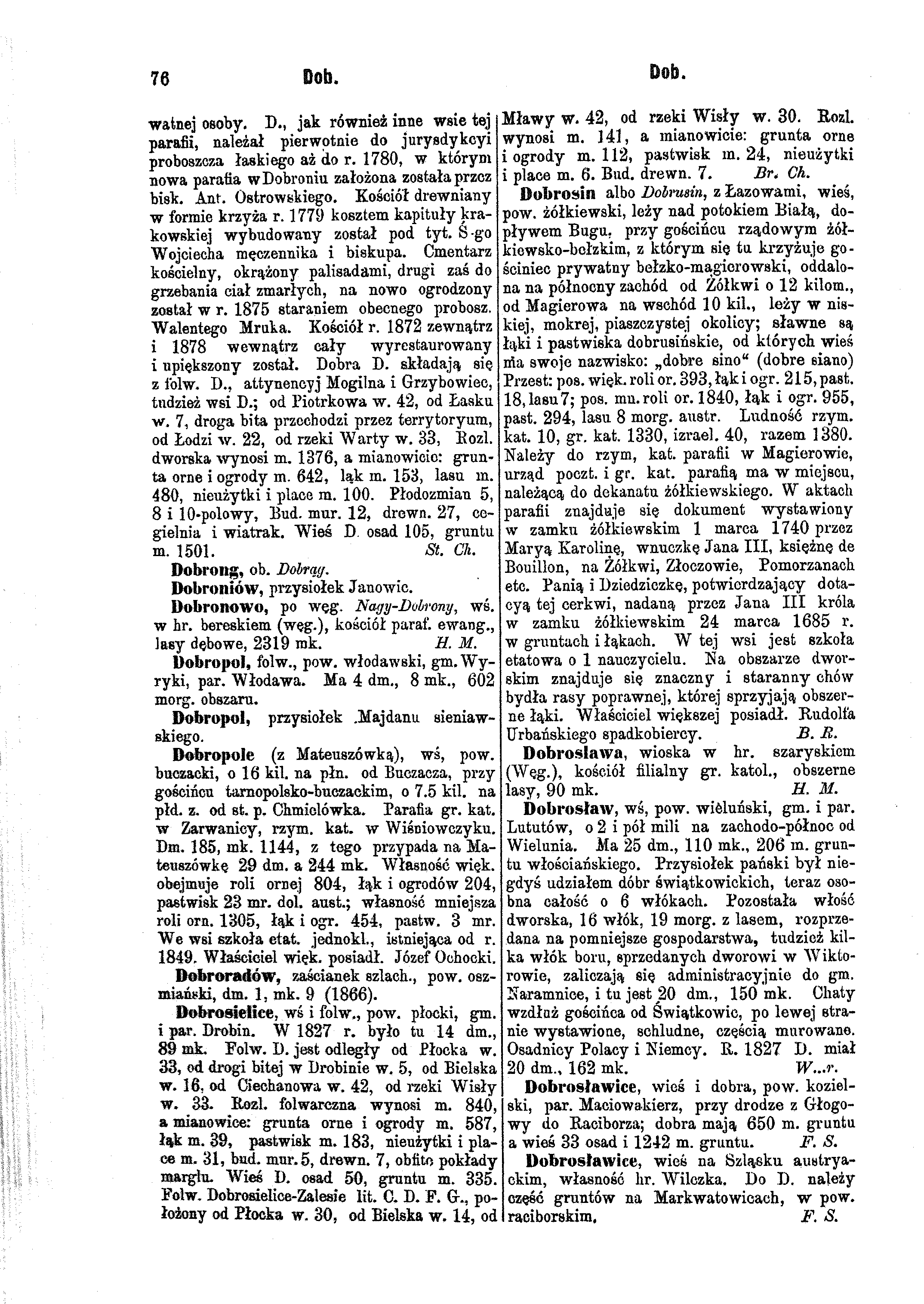
Gilberto is correct about the name of the village. The only thing I can add is an entry from the Slownik Geograficzny for the village of Dobropole which also includes the village of Mateuszowka. If in the future I should learn of any usage/meaning of censualis which was peculiar to Poland, I'll inform you.
Hope the questions raised lead you down informative paths.
Dave
| Description: |
|
| Filesize: |
139 KB |
| Viewed: |
12661 Time(s) |
|
|
|
|
dnowickiPO Top Contributor
Joined: 28 Dec 2011
Replies: 2950
Location: Michigan City, IndianaBack to top |
Posted: Fri Jun 14, 2013 8:26 pm
Post subject:
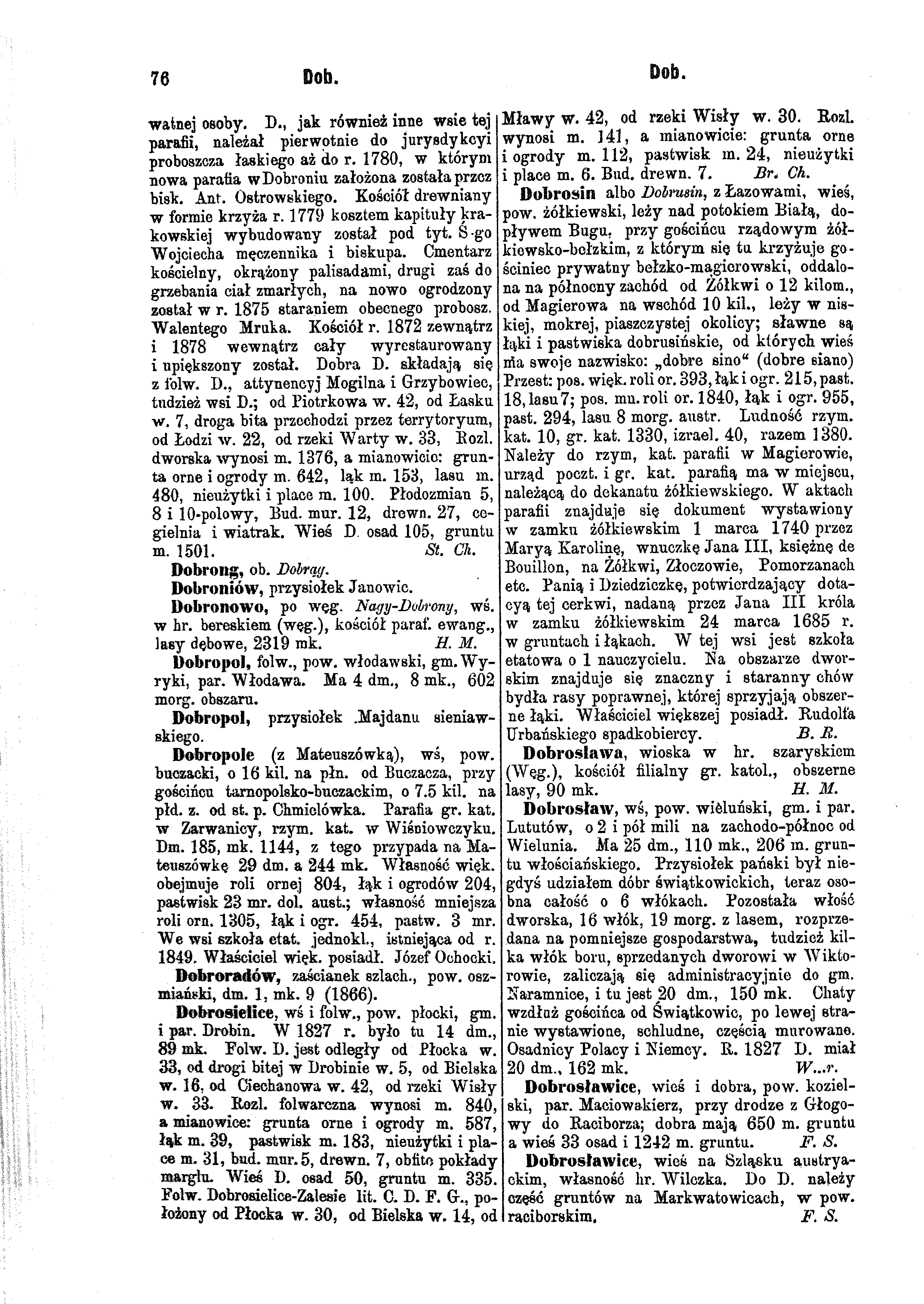
For some reason it seems that the entry from the Slownik Geograficzny will not open. I will attempt to add it again. If the second attempt is not successful it can me viewed online at http://dir.icm.edu.pl/pl/Slownik_geograficzny The entry is in Tom II Strona 76
Dave
| Description: |
|
| Filesize: |
139 KB |
| Viewed: |
12655 Time(s) |
|
|
|
|
|
|
|







 FAQ
FAQ Search
 Memberlist
 Profile
 Log in to check your private messages
 Log in
 Register