rsowaPO Top Contributor

Joined: 09 Nov 2013
Replies: 177
Location: Dundee, Michigan, USABack to top |
 Posted: Sun Mar 08, 2015 7:38 am
Post subject: Mięcierzyn Chubki
Posted: Sun Mar 08, 2015 7:38 am
Post subject: Mięcierzyn Chubki
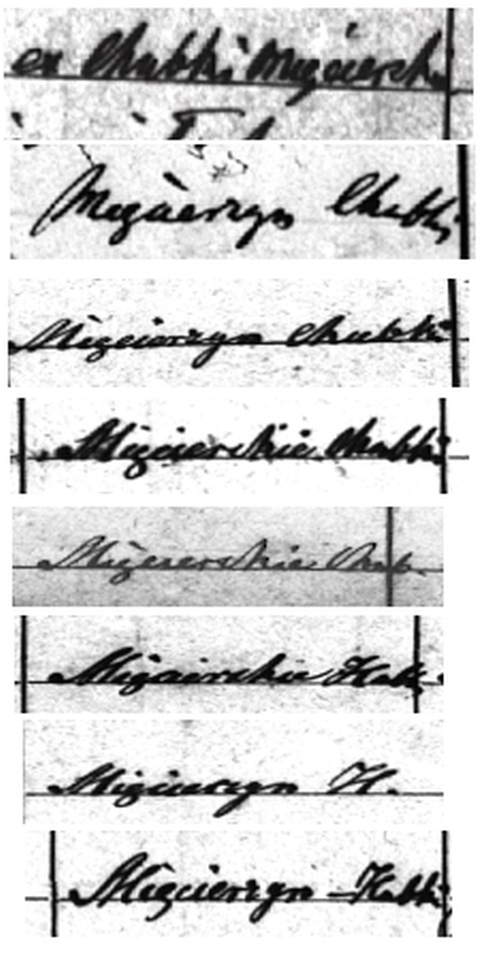
I found a dozen birth records for one of my Bejenka families in a place identified as (I think) Mięcierzyn Chubki.
The first image shows several of the citations from the baptismal records for Felix Bejenka's children around 1873-1885. His brother (my ancestor), Joannes Bejenka lived in nearby Cotoń.
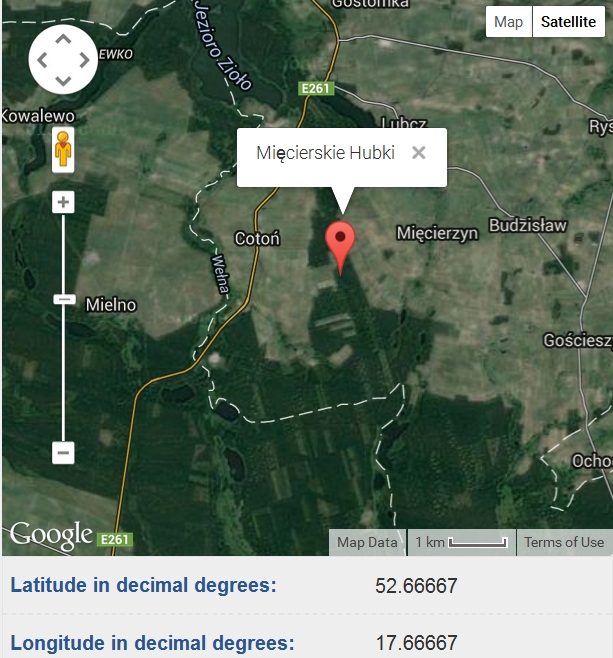
The second image is a map I found at http://www.citipedia.info/city/general/Poland__Kujawsko-Pomorskie_Mi%C4%99cierskie+Hubki_id_3092017.
My question has to do with the naming conventions for places like this. It's clearly not a village, but seems to be more like a collection of cottages, and was given a name to identify the place. In each of the parish records, it appears to be "Chubki" and in some of the Poznan Project village listings I found references to "(some name) Huby". Then on the map image it's "Hubki". My first thought was that it was a way to describe the area near Mięcierzyń, but not in town.
By the way, in nearly all of the baptismal records Felix is identified as "colonus", and in one "hortulanus". That tells me that he apparently owned his own cottage, but was farming land owned by someone else.
Thanks in advance,
Richard
| Description: |
|
| Filesize: |
203.63 KB |
| Viewed: |
5485 Time(s) |
|
| Description: |
|
| Filesize: |
252.54 KB |
| Viewed: |
5485 Time(s) |
|
|
|
|
Elzbieta PorteneuvePO Top Contributor
Joined: 09 Nov 2012
Replies: 3098
Location: Paris, FranceBack to top |
Posted: Sun Mar 08, 2015 9:54 am
Post subject: Re: Mięcierzyn Chubki
| rsowa wrote: | I found a dozen birth records for one of my Bejenka families in a place identified as (I think) Mięcierzyn Chubki.
The first image shows several of the citations from the baptismal records for Felix Bejenka's children around 1873-1885. His brother (my ancestor), Joannes Bejenka lived in nearby Cotoń.
The second image is a map I found at http://www.citipedia.info/city/general/Poland__Kujawsko-Pomorskie_Mi%C4%99cierskie+Hubki_id_3092017.
My question has to do with the naming conventions for places like this. It's clearly not a village, but seems to be more like a collection of cottages, and was given a name to identify the place. In each of the parish records, it appears to be "Chubki" and in some of the Poznan Project village listings I found references to "(some name) Huby". Then on the map image it's "Hubki". My first thought was that it was a way to describe the area near Mięcierzyń, but not in town.
By the way, in nearly all of the baptismal records Felix is identified as "colonus", and in one "hortulanus". That tells me that he apparently owned his own cottage, but was farming land owned by someone else.
Thanks in advance,
Richard |
Richard,
Mięcierzyn is a villlage name, today and in the past,
http://dir.icm.edu.pl/Slownik_geograficzny/Tom_VI/365
I read the second word on attached JPG as "chatki" not "chubki", which is straightforward: chatka = tiny house, a hut; chatki is plural of chatka.
Therefore Mięcierzyn Chatki is an area of huts, tiny houses in Mięcierzyn, collection of cottages.
Best,
Elzbieta
|
|
|
dnowickiPO Top Contributor
Joined: 28 Dec 2011
Replies: 2950
Location: Michigan City, IndianaBack to top |
Posted: Sun Mar 08, 2015 12:03 pm
Post subject:
Richard & Elzbieta,
I believe Richard's rendering of the name as "Chubki/Hubki" is correct but Elzbieta's explanation of the name referring to a collection of cottages is also correct. The map of the area shows three "Hubki" (First Hubki, Second Hubki, and Hubki Miecierskie). The listing from Mapa Szukacz describes the place as "czesc wsi" (part/portion of a village) i.e. of the village of Miecierzyn. The various "Hubki/Chubki" are colonies of the village of Miecierzyn. From what I found in Linde's Slownik Jezyka Polskiego (1807) "hubki" is related to "huba" which involves a measurement of land area in terms of a "wloka" which was equal to 30 morgs. A morg was equal to 55.987 ars and one ar equaled 100 square meters. Anyway these "Hubki" were outlying settlements or colonies of the central village which could be described in terms cottages situated on a certain area of land. It appears that the land was owned by the owner of the estate and village and were probably part of the folwarki (manor farmsteads) mentioned in the attached entry from the Slownik Geograficzny and thus it seems that the "Hubki" came into existence as part of the landowner's plan to make his holdings more productive.
The designation of Felix as "colonus/colonist" is not related to property ownership but rather to the fact he was one of the settlers (colonists) in the new settlement. He may or may not have owned his cottage in the new settlement but the word does not touch on that subject but only indicates that he was a settler in one of the new "Hubki". The word that does indicate that at some point he owned his cottage and sufficient land for a garden and possibly for the keeping of some farm animals is the record which describes him as a "hortulanus".
As an aside---Both Latin words mentioned are part of that group of Latin words from which 65% of English words are derived. It is easy to see how English words like colonist, colonial, colony, etc. are derived from Latin words like "colonia" and "colonus" and how words like horticulture are related to Latin words which are ultimately descended from the Latin word for a garden---hortus. An aside to the aside---the Latin phrase on the seal of the city of Chicago is "Urbs in horto" (A city in a garden) and it seems to me that must have been the idealistic description of the city after the implementation of Daniel Burnham's plan for the parkland of the city and not from a description of the natural topography of many parts of the area. If the motto would have come from a description of the area before development then the motto probably would have been "Urbs in palude" or "City in a swamp."
Dave
| Description: |
|
| Filesize: |
29.84 KB |
| Viewed: |
5485 Time(s) |

|
| Description: |
|
| Filesize: |
14 KB |
| Viewed: |
5485 Time(s) |

|
| Description: |
|
| Filesize: |
42.17 KB |
| Viewed: |
5485 Time(s) |

|
|
|
|
rsowaPO Top Contributor
Joined: 09 Nov 2013
Replies: 177
Location: Dundee, Michigan, USABack to top |
Posted: Sun Mar 08, 2015 1:05 pm
Post subject:
Absolutely amazing. Thanks Elzbieta and Dave...that kind of insight brings our ancestors to life! The curious thing, however, is that the distances involved are very small. From the village of Mięcierzyn to Hubki Miecierskie is only about 2 km, about a 40 minute walk from the east.
Felix brother, Joannes Belenka lived in Cotoń (a 40 minute walk from the west) and his first born child was born in Hubki Miecierski, so it could be that the whole family was working in the new settlement. Joannes was listed in his records as "operarius", or day laborer. So I suspect he got work wherever he could. In fact, that lack of steady work was probably one of the reasons Joannes and his whole family immigrated around 1888-1891.
Thanks again!
Richard
|
|
|
|
|
|







 FAQ
FAQ Search
 Memberlist
 Profile
 Log in to check your private messages
 Log in
 Register