PolishLibrarianPO Top Contributor
Joined: 28 Aug 2010
Replies: 323
Back to top |
 Posted: Sun Jun 28, 2015 9:59 pm
Post subject: Re: Two words for PL
Posted: Sun Jun 28, 2015 9:59 pm
Post subject: Re: Two words for PL
| dnowicki wrote: |
The only word that I know of which would match with the abbreviation invalid. is the adjective invalidus, invalida, invalidum meaning not strong or vigorous, weak, feeble, not strong in health, infirm, ill, sick, sickly,invalid, and the like. Given that the word appears in a death record, probably the most appropriate understanding of the word is that it describes the deceased as an invalid.
The second word is the noun exemptuarius, exemptuarii, m. and means a former buyer or purchaser. Most people have seen the Latin word emptor, emptoris, m. meaning a buyer as in the well known phrase "Caveat emptor" (Buyer beware) but not the noun emptuarius, emptuarii, m. meaning a buyer or purchaser. It has always seemed to me that emptor was used for someone who was making a one time purchase and emptuarius was used for someone whose occupation was buying (and selling) goods.
Dave |
Thanks Dave. That was my first inclination to think that invalid. might mean someone weakened or that he was an invalid. Since my recollection of my 3 or 4 yrs. of HS Latin is pretty limited, I wasn't sure what to add to invalid to come up with a Latin word (a perfect example of when a hard copy dictionary would come in handy!). This Czech parish calls these Burial (not Death) records, and doesn't give much information (e.g. no spouse info) which makes it hard to figure which Franciscus, son of Franciscus died. 
Even emptor does not appear in the FamilySearch Latin Word List, although Google Translate recognizes it. Google Translate doesn't recognize exemptuarius either, but does ex-emptor as ex-buyer as you so ably explained. I'm sure this info will be of use to someone else on the Forum. I know I've just gone back and read what you posted about consanguinity, as I have run across this dispensation twice today in records I was examining from the 1700s. Have a good week! ~PL
|
|
|
nercellPolishOrigins Patron
Joined: 21 Aug 2014
Replies: 287
Back to top |
|
dnowickiPO Top Contributor
Joined: 28 Dec 2011
Replies: 2950
Location: Michigan City, IndianaBack to top |
Posted: Tue Jul 07, 2015 8:40 pm
Post subject: Piotr Tylicki Entry
Nancy,
I doubt that this passage will help you to understand Piotr Tylicki's coat of arms. The image and the description of the coat of arms are found on page 185 (image 203) of the text but it is a coat of arms he shared with a fairly large number of individuals. It is the coat of arms of the gens Lubicz of which evidently he was a member. Rather than provide a translation of the description of the arms it would be just as easy to Google Lubicz where you will find color images of the crest. (Much of the Latin description deals with the colors of the various features on the arms.)
The book itself was written by Szymon Okolski and evidently was published in 1641 (at least the date of the royal warrant of Wladyslaw IV [Vasa] is February 24, 1641). It has some information of value and/or interest regarding particular individuals but if one were to read it as bedtime reading the main value would be as a cure for insomnia. Since I don't suffer from insomnia, I skimmed through enough sections to get a good feel for the work and left it at that. The section you wanted translated, as you will see in the actual translation, contains very little of the type of information you mentioned. It consists of a listing of his titles followed by an ode to him (perhaps the inscription on his tomb). I didn't scan the poetry to determine the meter. (The verse is typical of Classical Latin poetry where the meter is determined by the number of feet in a line based on the number and arrangement of long and short vowels in each foot. Latin poetry of this time had reverted to the Classical style of poetry as opposed to the Medieval style.) Then the selection concludes with information about another Tylicki.
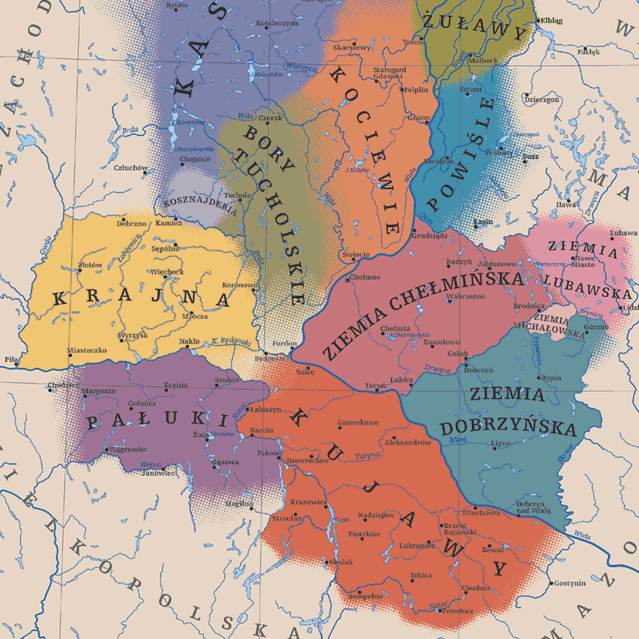
Using that passage and the wiki article as a starting point I did some research and found some some interesting tangential information----at least information I found interesting. The attached maps show the Kujawy region and the nearby regions of Poland since he was born in Kowal, a royal town in Kujawy. Since my paternal ancestors and some of my maternal ancestors were from villages and towns near Kowal, I already had those maps and thought that you might find them helpful or interesting.
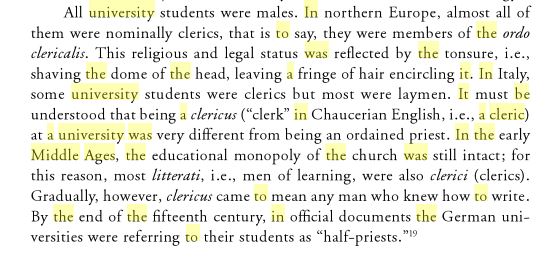
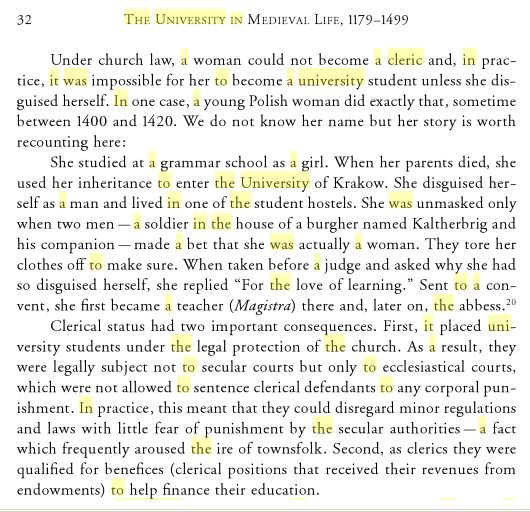
Something of interest in the Wiki article is that he was not ordained as a deacon until age 45 but evidently had been a cleric in minor orders from the time he was a student at the Krakow Academy (Jagiellionian University) since students and teachers at European Universities at the time were usually clerics. One became a cleric by receiving the tonsure and, if a person had a desire to enter the priesthood, the minor orders (porter, lector, acolyte, and exorcist) followed by the major orders (sub-deacon, deacon, presbyter [i.e. priest and possibly bishop]. We can infer that he was a career official of the royal curia and only entered major orders when the opportunity arose to become a bishop. I came across the reference to the young lady in Poland who entered the U. of Krakow in disguise---perhaps one of the first woman's rights heroines in the country, if the story is factual. When looking back at her, modern Poles can certainly say: "You've come a long way, baby!"
The translation is posted as a PDF.
Hope you find it somewhat helpful.
Dave
| Description: |
|
| Filesize: |
54.61 KB |
| Viewed: |
13143 Time(s) |
|
| Description: |
|
| Filesize: |
91.85 KB |
| Viewed: |
13143 Time(s) |
|
| Description: |
|
| Filesize: |
32.13 KB |
| Viewed: |
13143 Time(s) |

|
| Description: |
|
| Filesize: |
151.17 KB |
| Viewed: |
13143 Time(s) |
|
| Description: |
|

Download |
| Filename: |
Tylicki.pdf |
| Filesize: |
14.38 KB |
| Downloaded: |
674 Time(s) |
|
|
|
nercellPolishOrigins Patron
Joined: 21 Aug 2014
Replies: 287
Back to top |
Posted: Fri Jul 10, 2015 8:40 pm
Post subject:
Thanks much Dave...I definitely plan on reading up on the Kujawy region.
Appreciated,
Nancy
|
|
|
Posted: Tue Jul 14, 2015 7:53 pm
Post subject:
Dave
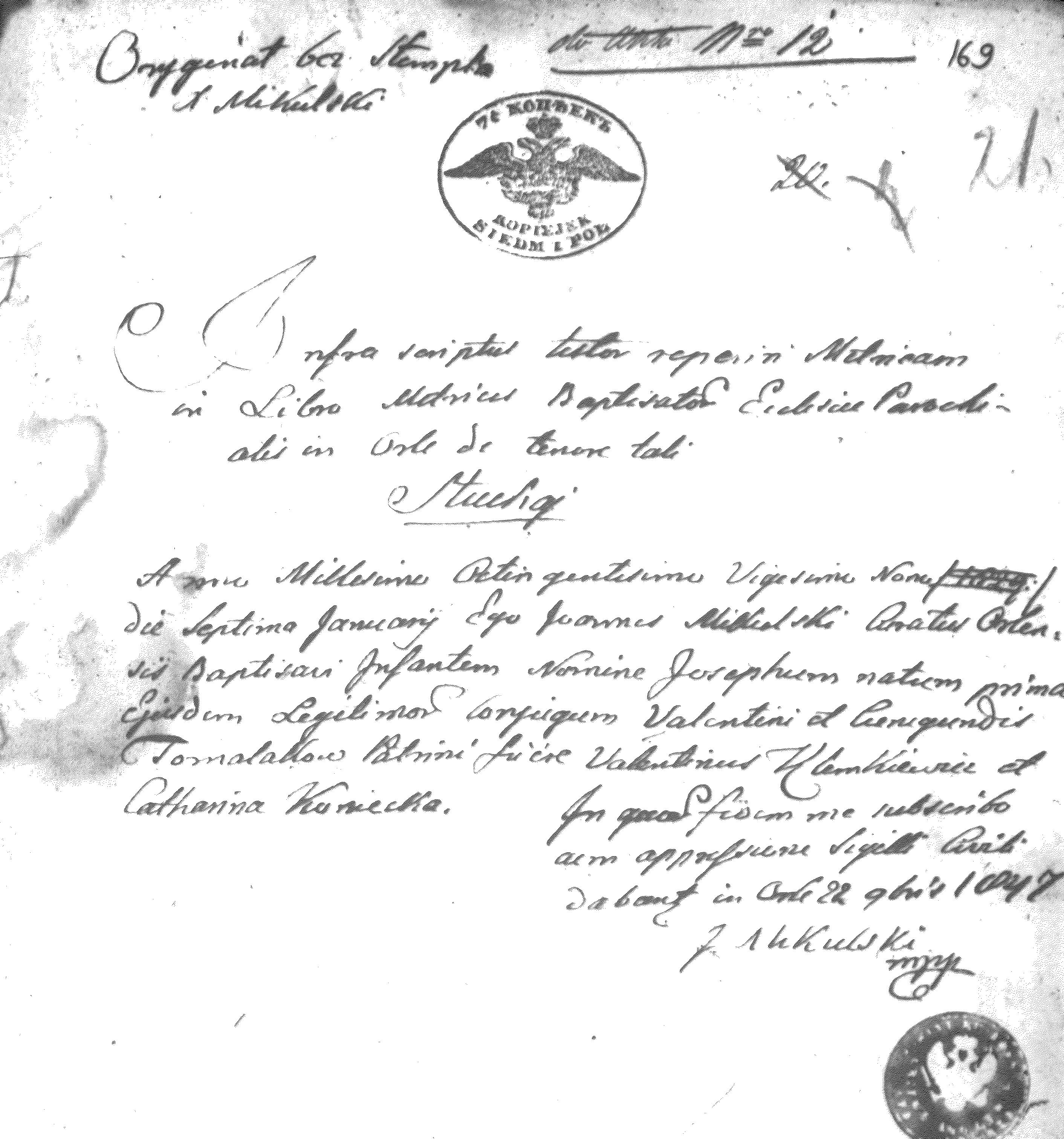
When you get a chance please translate this document which again was found with a marriage record.
Thanks,
Andy
| Description: |
|
| Filesize: |
1.2 MB |
| Viewed: |
13143 Time(s) |
|
|
|
|
dnowickiPO Top Contributor
Joined: 28 Dec 2011
Replies: 2950
Location: Michigan City, IndianaBack to top |
Posted: Fri Jul 17, 2015 10:40 am
Post subject: Birth/Baptism Record with Marriage Act
Andy,
The probable reason this birth/baptism certificate was filed with a marriage record is that it provides proof of data which was entered in the marriage record of Jozef Tomalak. It is a good example which explains statements which are sometimes found in long paragraph civil marriage acts. Although by the time this certificate was issued (1847) the formulas used in marriage acts had changed/been simplified from the early format found during the time of the Duchy of Warsaw and continuing into the early years of the Congress Kingdom of Poland, it appears that documentation of birth/baptism was still expected for civil acts. Although this is a Latin transcript of an ecclesiastical record we can tell that it was required for a civil act because it lacks the parish seal and instead contains two notations in Polish as well as a civil seal and a civil revenue seal/stamp. When early civil marriage acts contain the statement "...podlug metryki zlozonej wycietej z ksiag..." ("according to the submitted metrics extracted [also translated as "cut out"] from the register...") this is the type of metric to which those acts refer.
Anyway, here is the translation.
Dave
Latin Text: Oryginal bez stempla.* X Mikulski; do akta Num. 12 (Notations in Polish); Civil Revenue stamp for 7 & 1/2 kopecs
Infra scriptus testor reperi metricam in Libro Metrices Baptisatorum Ecclesiae Parochialis in Orle de tenore tali:
Sluchaj
Anno Millesimo Octingentisimo Vigesimo Nono /1829/ die Septimo Januarij Ego Joannes Mikulski curatus Olensis baptisavi infantem nomine Josephum natum prima ejusdem Legitimorum Conjugum Valentini et Cunegundis Tomalakow. Patrini fuere Valentinus Ulemkiewicz et Catharina Koniecka.
In quorum fidem me subscribo ac appressum sigillo civili dabantur in Orle 22 9bris 1847
X Mikulski
Civil Seal
Translation: The original (record) is without the revenue seal/stamp.* Priest Miklski; (In reference) to Act #12; Civil Revenue stamp for 7 & 1/2 kopecs
I, the undersigned, attest that a metric (record) is found in the Metrical Register of Baptisms of the Parish Church of Orle as follows:
(The village of) Sluchaj
On the seventh day of January in the year One Thousand Eight Hundred Twenty-nine /1829/ I, Jan Mikulski, the curate of Orle, baptized an infant by the name of Jozef, born on the first of the same (month & year) of the legitimate marriage of Walenty and Kunegunda/Kinga Tomalak. The sponsors were Walenty Ulemkiewicz and Katarzyna Koniecka.
In testimony of which I sign below and impress the civil seal; Given in Orle on November 22, 1847.
Note: *The original entry in the parish baptismal register obviously would not contain the civil revenue stamp required on this transcribed certificate.
|
|
|
Posted: Wed Jul 22, 2015 7:43 am
Post subject:
Dave,
At your convenience please translate this record. Thanks in advance.
George
| Description: |
|
| Filesize: |
37.39 KB |
| Viewed: |
13142 Time(s) |

|
|
|
|
dnowickiPO Top Contributor
Joined: 28 Dec 2011
Replies: 2950
Location: Michigan City, IndianaBack to top |
Posted: Thu Jul 23, 2015 7:21 pm
Post subject: Death & Burial of Malgorzata Klososka
George,
This record contains more informative details than many such records.
Dave
Latin Text: In Left Margin: Srocko; 1812 die 20 8bris
Body of Entry: Obiit mulier maritata nomine MARGARETHA uxor Francisci Klososki, murarii ac cauponis, filia Valentini Borowicz et Margarethae, textoris lini ex Kostrzyn munita Sacramentis ac quinque annis aegrotans, hydropisi* mortua et sepulta in Caemeterio ad ortum---annorum 40.
Translation: In Left Margin: (The village of) Srocko; The 20th day of October, 1812
Body of Entry: A married woman by the name of MALGORZATA, the wife of Franiszek Klososki, a mason (i.e. a stone mason or a bricklayer) and an innkeeper/tavern-keeper, the daughter of Walenty and Malgorzata Borowicz, a linen-weaver from Kostrzyn, died, strengthened by the Sacraments and being ill for five years; she died of edema* and was buried in the (parish) cemetery towards the East----40 years of age.
Note: *The disease from which she suffered is known as edema or hydrops or dropsy and describes an illness in which fluids build up in a person's body.
|
|
|
starshadowPO Top Contributor
Joined: 09 May 2013
Replies: 306
Back to top |
Posted: Mon Jul 27, 2015 2:43 am
Post subject:
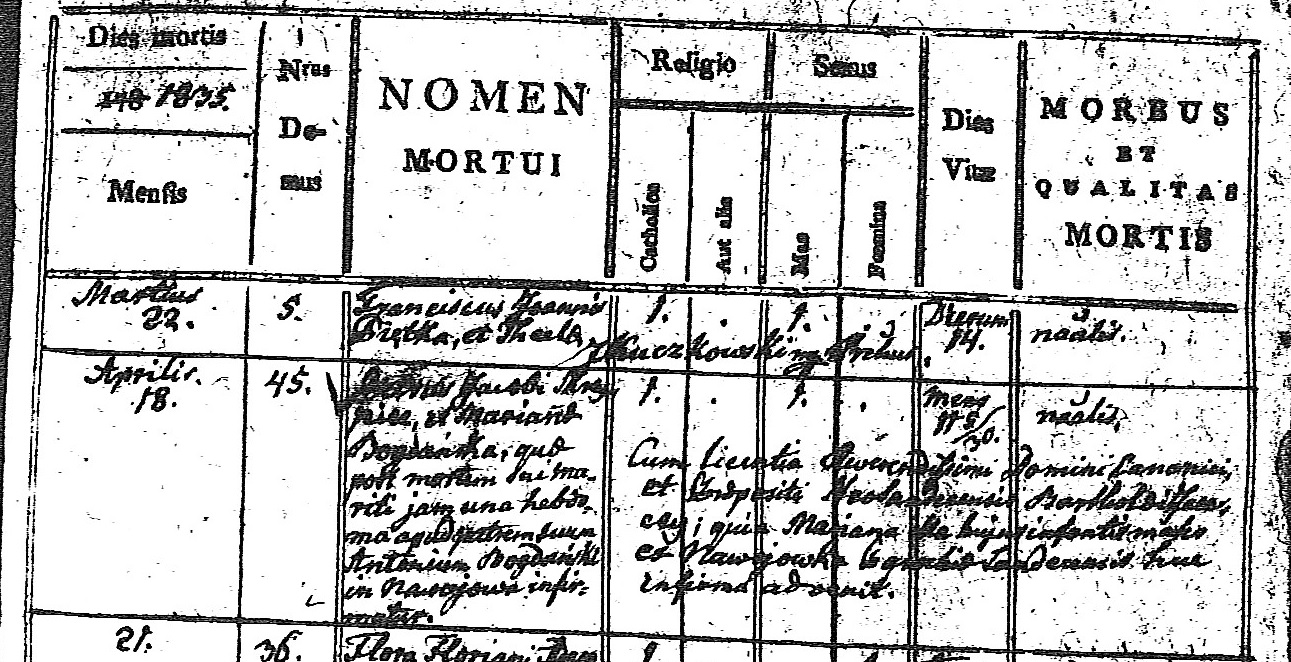
Please help me translate this 1835 death record. It's the 2nd from the top. I believe it's for an infant named Petrus, son of Jacob Skrzypiec and Marianna Bogdanska. There are some notes I'm not quite able to make out. I believe it also mentions Antonius Bogdanski, but does it say if he is Marianna's father?
| Description: |
|
| Filesize: |
469.73 KB |
| Viewed: |
13142 Time(s) |
|
|
|
|
dnowickiPO Top Contributor
Joined: 28 Dec 2011
Replies: 2950
Location: Michigan City, IndianaBack to top |
Posted: Mon Jul 27, 2015 9:42 pm
Post subject: Death of Piotr Skrzypiec
Starshadow,
Antoni Bogdanski is indeed Maryanna's father. Apparently Jakub died recently and so Maryanna went to stay at her father's house. The second notation (in columns 4-9) deals with formalities of permission for the burial to Piotr to take place. There are a couple of words in the permission notation where I am unable to determine the letters as written and I'm not sure of the geographical locations mentioned there. There are several things about the geography of Austrian Partition records which are difficult for me: 1) The name of the parish does not usually appear in the record which makes getting a handle on the geography less than certain; and 2) because all my ancestors were from Wielkopolskie and Kujawsko-Pomorskie my familiarity with the towns and villages of the Austrian Partition is rather limited. For locations in the record of which I'm uncertain a question mark in parentheses will follow the name of the location.
On page 210 of Polish Records Translations I posted a response to causes of death in records from the various partitions. There I said that I could only remember seeing a column for the disease and type of death as far back as the second quarter of the XIXth Century. Although this record fits into that same time frame, the printed register has a printed year for the 1780s which year was crossed out and the handwritten year 1835 was entered. Thus it is safe to say that cause of death information was to be entered beginning at least during the 1780s in the Austrian Partition.
Anyway, here is the translation.
Dave
Col. 1: Date of death: April 18, 1835
Col. 2: House Number 45
Col. 3: Name of the deceased: Petrus Jacobi Skrzypiec et Mariannae Bogdanska, quae post mortem sui mariti jam una hebdoma apud patrem suum Antonium Bogdanski in Nawojowa infirmatur. = Piotr, (the son) of Jakub Skrzypiec and of Maryanna Bogdansk, who after the death of her husband, already one week at the house of her father Antoni Bogdanski in Nawojowa, became ill.
Col. 4: Catholic: Checked
Col. 5: Blank
Col. 6: Male: Checked
Col. 7: Blank
Col. 8: Age (Literally: "Days of Life"): Menses 11 5/30 = 11 months (I take the 5/30 to be Piotr's date of birth = May 30, 1834)
Col 9: Disease & Type of Death: na(tur)alis = natural (The mark above the second "a" indicates that the entry is a contraction.)
Notation in Col. 4-9: Cum licentia Reverendissimi Domini Canonici et ???positi (possibly: praepositi) Neosandacensi Bartholo???? quia Marianna (illegible word) hujus infantis mater ex Nawojowka parochiae Sandacensis huc infirma advenit. = With the permission of the Most Reverend Canon and (possibly: dean) of Nowy Sacz (?), Bartolomej illegible surname since Maryanna, (illegible short word) the mother of this infant from Nawojowka(?) of the parish of Sacz (Stary Sacz?) arrived there ill.
Notes on Latin pronouns in this record:
1. quae is the nominative singular feminine of the relative pronoun qui, quae, quod (who) and thus must refer to Maryanna
2. sui and suum are forms of the third person reflexive pronoun and thus refer to the subject of the clause in which they appear which in this case is the relative pronoun quae which refers to Maryanna. (The Polish relative pronoun for qui, quae, quod is ktory, ktora, ktore and the Polish possessive reflexive is swoj, swoja, swoje. These words operate the same way grammatically in both Latin and in Polish.)
Last edited by dnowicki on Tue Jul 28, 2015 6:49 am; edited 2 times in total
|
|
|
starshadowPO Top Contributor
Joined: 09 May 2013
Replies: 306
Back to top |
Posted: Tue Jul 28, 2015 5:10 am
Post subject:
Thanks so much Dave. This one record explains a lot, a great new piece of the puzzle to have.
|
|
|
jackiewisniewski

Joined: 01 Jan 2011
Replies: 51
Location: Riverside, IL., USABack to top |
Posted: Fri Jul 31, 2015 2:02 pm
Post subject: Latin Comments on Marriage Record
Hi Dave,
When you have a chance, can you shed some light on the comments written on the attached marriage record? I already know what each column is for and have translated the bride and groom's information, but it looks like the marriage was dissolved (it's the only word that's clear to me), and I'm curious whether the record says why.
Thank you in advance! 
Jackie
| Description: |
| 1922 Marriage for Jozef Klimek and Maria Piszczkiewicz |
|
| Filesize: |
62.51 KB |
| Viewed: |
13141 Time(s) |

|
|
|
|
dnowickiPO Top Contributor
Joined: 28 Dec 2011
Replies: 2950
Location: Michigan City, IndianaBack to top |
Posted: Sat Aug 01, 2015 7:53 pm
Post subject: Dissolution of Klimek & Piszczkiewicz Marriage
Jackie,
You are correct that the marriage was dissolved and the record does give the reason. It had been proved that the marriage fell into the category of "ratum, sed non consumatum" ("ratified, but not consummated"). In other words, the couple went through the proper Catholic marriage ceremony (ratum) but never consummated the marriage through marital intercourse. I did a bunch of research on the topic and this is what I learned: 1) Marriage was and is viewed as a "contract" between the bride and the groom; 2) The marriage ceremony ratifies the contract; 3) However, the contract must be physically consummated through conjugal relations for the contract to be complete; 4) There is a difference between the dissolution or dissolving of a marriage and an annulment---a dissolution does just what it says---it "dissolves" the marital bond. An annulment declares that the apparent marriage was never genuine.
Here is the pertinent canon from the 1917 Code of Canon Law (which was in force at the time this marriage was dissolved). Canon 1119: Matrimonium con consummatum inter baptizatos, vel inter partem baptizantam et partem non baptizantam, dissolvitur tum ipso iure per sollemnam professionem religiosam tum per dispensationem a Sede Apostolica ex iusta causa concessam, utraque parte rogante vel alterutra etsi altera sit invita. (A non consummated marriage between baptized persons or between a baptized party and a non-baptized party first by the law itself through solemn religious profession or then by a dispensation granted by the Apostolic See for a just cause if both parties ask (for the dissolution) or if one party asks even if the other party is unwilling.) The notation indicates that this marriage was covered by the second instance listed in the canon and was dissolved by the Apostolic See. Thus the easy and clear part....but now comes the part which is less clear and rather confusing. The dissolution of this marriage is noted twice and then the first notation of the dissolution is crossed out and another notation stating the same thing is entered in the record. The tough part is that not all the words are as clear as one would like due to one entry being crossed out and due to the fact that both notations are entered over the original marriage entry. The confusing part is why was the notation entered once, crossed out, and entered again. Inquiring minds want to know, but there doesn't seem to be an answer. Anyway, here are the two entries minus words which are illegible.
Original Entry (Crossed Out): Aspernatio super matrimonio non consummato (illegible word) Congregatione de Sacramentis die 27. V. 1936 No. 2472 Tarnoviense de die 15. (illegible numeral). 1938 a. 2.5(illegible numeral)
Translation of Original Entry (Crossed Out): The disregarding/dissolution of a non-consummated marriage (illegible word) by the Congregation for the Sacraments on the day of May 27, 1936 Number 2472 at Tarnow on the 15th day of (illegible numeral for the month) in the year 1938 2.5 (illegible numeral).
Second Entry: Iuxta ordinationem Curiae Ep(isco)palis Tarnov(iensis) diei 19.2. 1941 N. 799 matrimonium hoc est dissolutum (illegible preposition) dispensationem apostolicam (illegible word) 27.5.1936 No. 2472.
Translation of second entry: In accord with the decree of the Episcopal Curia/Chancery of Tarnow of February 19, 1941 Number 799 this marriage was dissolved (by or through) the apostolic dispensation (illegible word) of May 27, 1936 Number 2472.
As you can see, the bishop's chancery in Tarnow twice declared the marriage dissolved by the same papal dispensation dated May 27, 1936 Number 2472. Why the chancery in Tarnow first declared the marriage dissolved in 1938 and then again in 1941 based on the same apostolic
decree of 1936 is a mystery to me.
Hope this answers you question.
Dave
|
|
|
jackiewisniewski
Joined: 01 Jan 2011
Replies: 51
Location: Riverside, IL., USABack to top |
Posted: Sat Aug 01, 2015 9:28 pm
Post subject:
That is fascinating Dave! Thank you so much for all of the additional information and research! The marriage being dissolved for lack of consummation was so surprising that I actually laughed when I read it. Historically my ancestors from this area wasted no time having many children per couple. Although the number of children each wife gave birth to (on average) in the early 1900's was less than in the 1800's, I sort of expected to see that. But this is definitely the first time I've seen a marriage dissolved within the records. It really just brings up so many more questions!
I know Jozef died in 1944, but I'll never know the circumstances surrounding why they would wait 14 years before having the marriage dissolved! Or why they bothered to get married at all? And how can it be proven after 14 years that the marriage was never consummated?
Then again, it would almost be abnormal to get an answer to a question that doesn't naturally just keep creating more questions we're not likely to get answers to lol
Thank you again, your help is always appreciated!
Jackie
|
|
|
nercellPolishOrigins Patron
Joined: 21 Aug 2014
Replies: 287
Back to top |
Posted: Sat Aug 08, 2015 2:33 pm
Post subject: Proof of nobility
Hi Dave,
I hope your summer has been an enjoyable one.
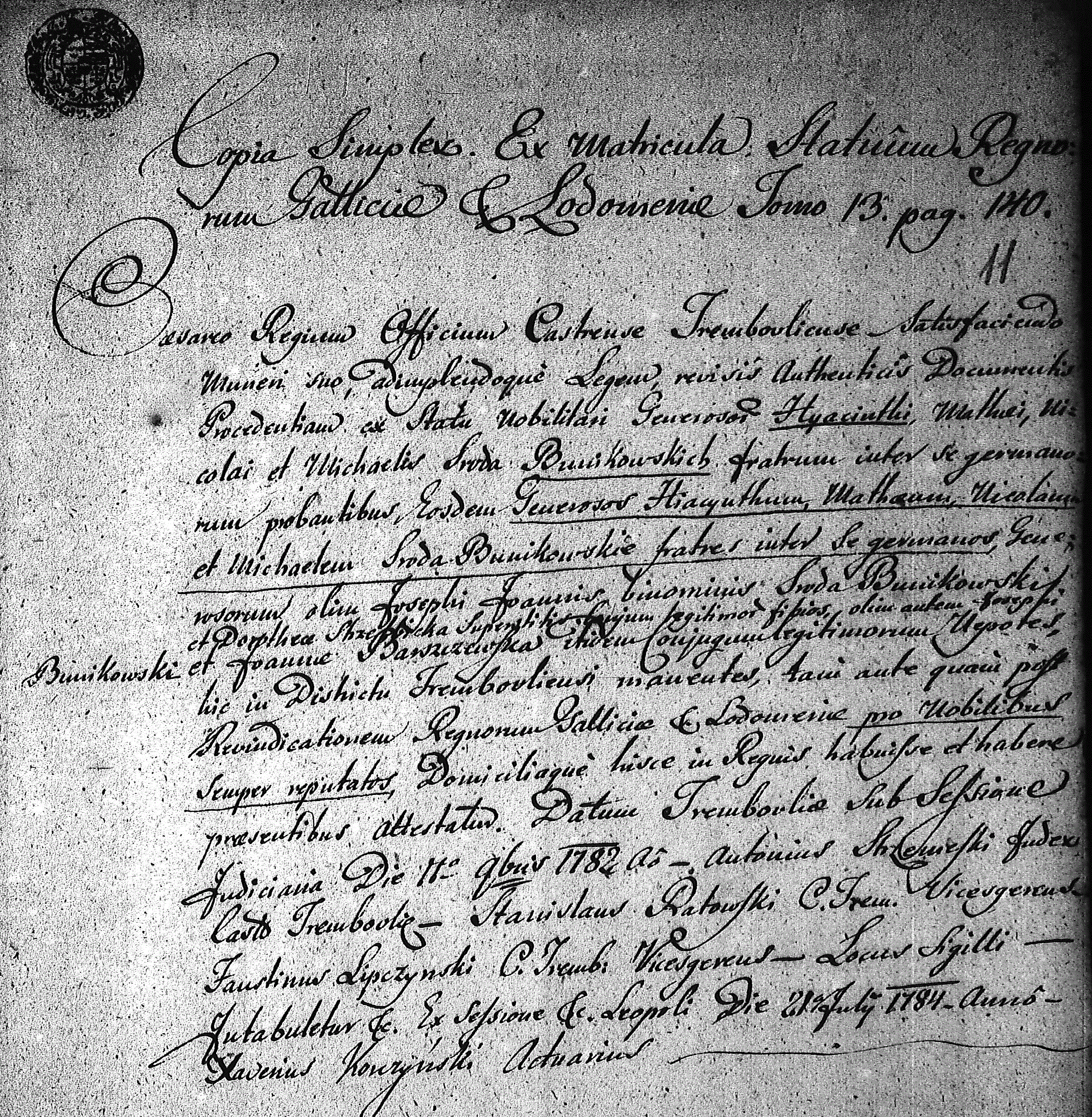
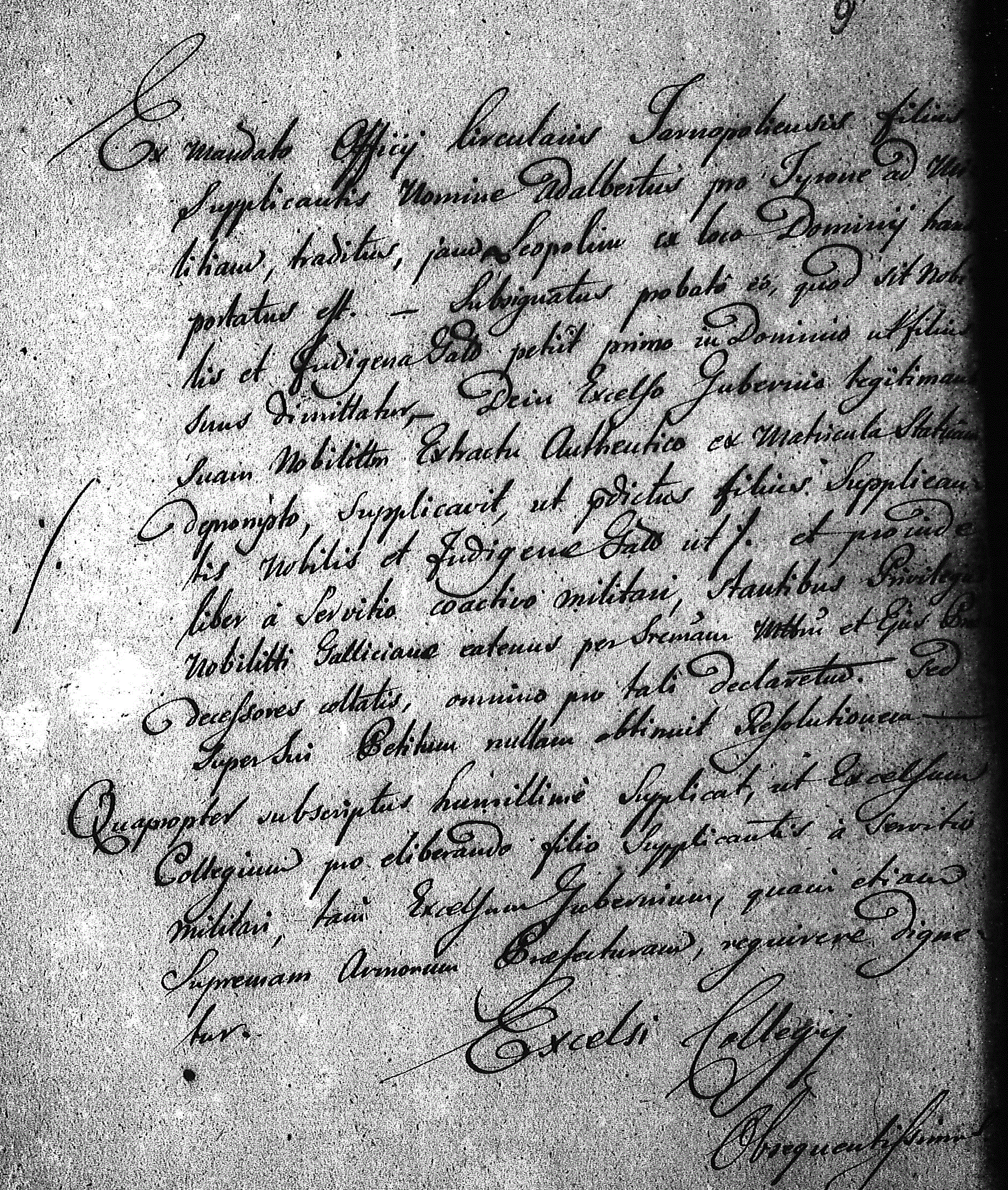
I have a couple of Latin translations needed in reference to a post in the Polish Forum on May 5th 2015 p 195....Jacek, Mateusz, Mikołaj i Michał Środa Bunikowscy dowiedli szlachectwa w Galicyi 1782 r. w sadzie grodzkim trembelowskim (Goł.) You can see that these names were listed under a reference to my ancestral village of Bonkowo Podlesne (then B. Wittach) Unfortunately, after obtaining the proof of nobility record from the LDS, they do not appear to be of my direct line. Still, I am hoping that I can somehow make a connection.
Much appreciated,
Nancy
| Description: |
|
| Filesize: |
1.82 MB |
| Viewed: |
13138 Time(s) |
|
| Description: |
|
| Filesize: |
1.65 MB |
| Viewed: |
13138 Time(s) |
|
|
|
|
|
|
|









 FAQ
FAQ Search
 Memberlist
 Profile
 Log in to check your private messages
 Log in
 Register