



 Posted: Thu May 21, 2026 2:40 am
Post subject: Re: Marriage Record for translation
Posted: Thu May 21, 2026 2:40 am
Post subject: Re: Marriage Record for translation


 Posted: Thu May 21, 2026 12:38 pm
Post subject: Re: Marriage Record for translation
Posted: Thu May 21, 2026 12:38 pm
Post subject: Re: Marriage Record for translation
| herb43 wrote: |
| https://metryki.genealodzy.pl/index.php?
op=pg&id=3270&se=&sy=1873&kt=2&plik=002.jpg&x=0&y=36&zoom=4.68 Tomasz Nyzio & Zofia Kawecka Marriage Record |
Posted: Thu May 21, 2026 1:18 pm
Post subject:
Posted: Yesterday at 6:14 pm
Post subject: Pauper de Xenodochio
| Krupinski-Kaspar-1834.04.14-Death.jpg | ||
| Description: |
|
|
| Filesize: | 167.5 KB | |
| Viewed: | 0 Time(s) | |
 |
||
| Krupinski-Kaspar-1834.01.06-Birth.jpg | ||
| Description: |
|
|
| Filesize: | 241.33 KB | |
| Viewed: | 0 Time(s) | |
 |
||
Posted: 18 hours ago at 5:19 pm
Post subject: Re: Pauper de Xenodochio
| cpkaway wrote: |
| https://archium.tsdial.archives.gov.ua/file-viewer/230964#file-1735909
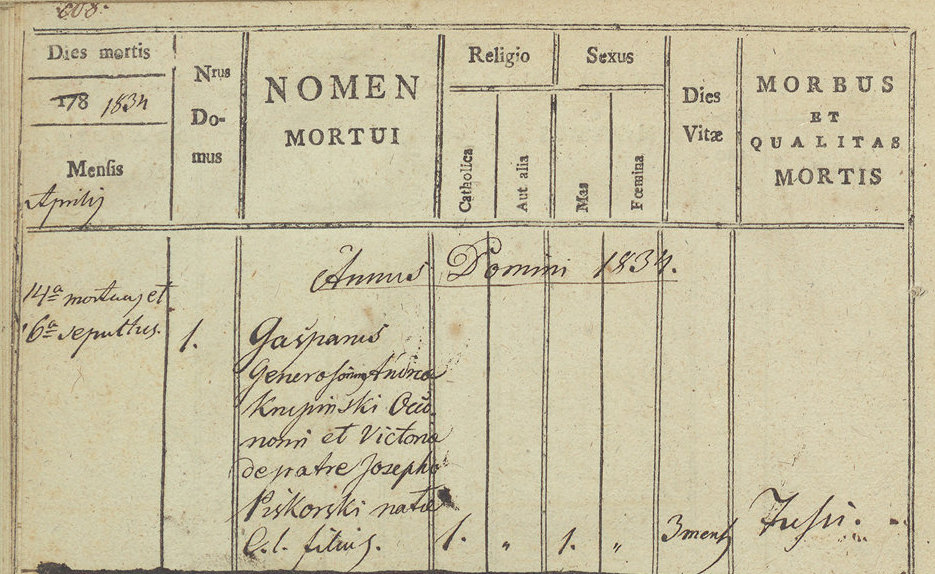
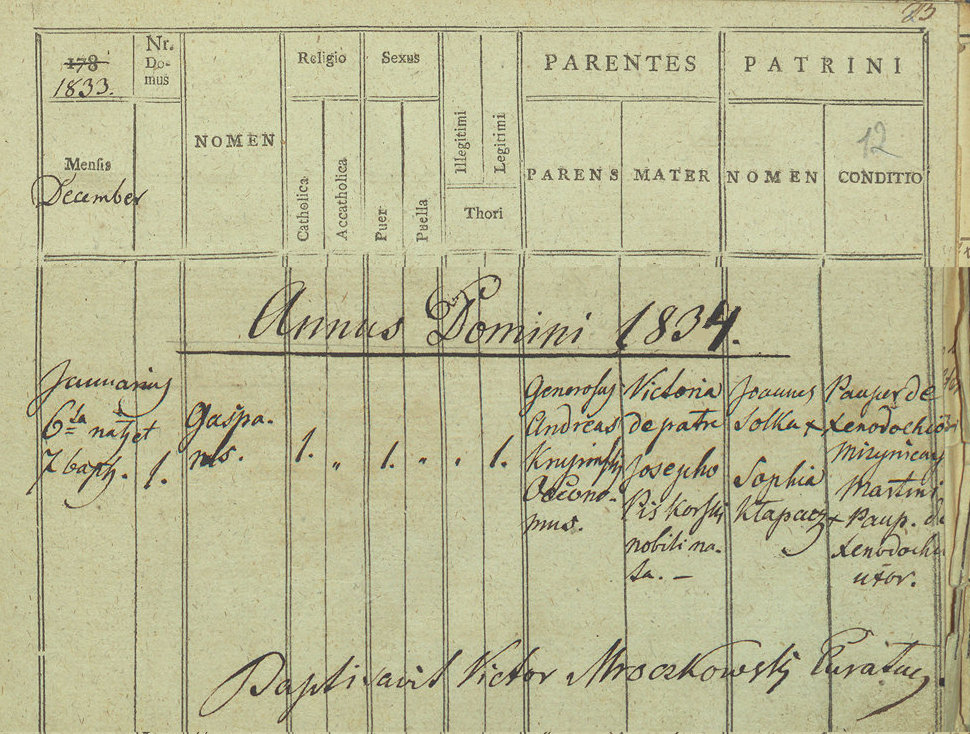
https://archium.tsdial.archives.gov.ua/file-viewer/230964#file-1735894 Hello David, I came across an unusual birth record from Dzodowice (Galicia) where the godparents are both described as Pauper de Xenodochio Mirynicay Martini The three other children born before Kaspar had godparents of similar upper social status. Why would people in a poor house be chosen as there must have been some financial obligation to being a godparent? It would seem an unfair burden to put on them. Also, is there any significance to the "x" after the godparents names? On the death record: Gasparus, Generoso??? Andreas Krupinski oeconomi et Victoria de patre Josepho Piskorski Hi Chris, Why would people in a poor house be chosen as there must have been some financial obligation to being a godparent? It would seem an unfair burden to put on them. As far as the Catholic Church is concerned there was and is no financial obligation to being a “godparent”/sponsor. Only one sponsor is required for baptism. In the early days of Christianity obviously converts were adults and the sponsor acted as a mentor for the convert. When infant baptism became the norm during the 5th Century & later a sponsor was still required, but only one. The custom arose to have two sponsors, a male and a female, who came to be popularly known as “godparents”. Their role continued in theory to be mentors in spiritual matters for the child. Thus no financial burden was attached to their role. Also, is there any significance to the "x" after the godparents names? Since records from Galicia are primarily civil records the Austrian government controlled the content. If the sponsors were literate the pretense was that they would sign the register—pure fiction since the record was composed by a scribe hired by the parish priest. The scribe was not present at the baptism and worked from notes provided by the priest in order to put the entry into the form required by the government. The X would either signify that the sponsor would have signed the register but was illiterate or simply that the sponsor was present for the baptism. Personally I believe that it is not a good idea to have a priest, whose role in life is religious, act as a civil registrar. It destroys the separation of Church & State and does no justice to either. I understand that it was done because it was expedient at that time and place but it was light years away from being a good solution. On the death record: Gasparus, Generoso??? Andreas Krupinski oeconomi et Victoria de patre Josepho Piskorski nata C.l. filius What is the ending of "Generoso"? “orum” (Generosorm) the Genitive Plural since it modifies both husband & wife. The meaning is “well-born” (Polish: urodzony) and indicates that the couple owned at least one village. The baptism record indicates that the husband and wife were not of equal noble status. The father was Generosus/well-born and the mother was nobilis/noble which meant that her family owned or were lease-holders of a parcel of property. The meaning of "C.l."? Could it be "Catholica" and "Legitimi"? No. It stands for “Conjugum Legitimorum” and can be translated as “Of the legitimate/legal spouses” or “Of the legitimate/legal marital union.” Is cause of death "Tussis"? Yes. It appears in the entry as an Ablative of Cause (thussi = from a (whooping) cough. Bonus—The child was born on January 6, the Feast of the Epiphany in the Liturgical Calendar. Tradition ascribed the names Kacper/Kacpar, Melchior/Melkjor, and Baltazar to the magi so he was given the name of the first of the three. His Name Day and his birthday were identical. I hope the answers clarify the text for you. Dave nata C.l. filius What is the ending of "Generoso"? The meaning of "C.l."? Could it be "Catholica" and "Legitimi"? Is cause of death "Tussis"? Thank you Chris |
Posted: 16 hours ago at 7:14 pm
Post subject: Re: Pauper de Xenodochio
 FAQ
FAQ Search
 Memberlist
 Profile
 Log in to check your private messages
 Log in
 Register